
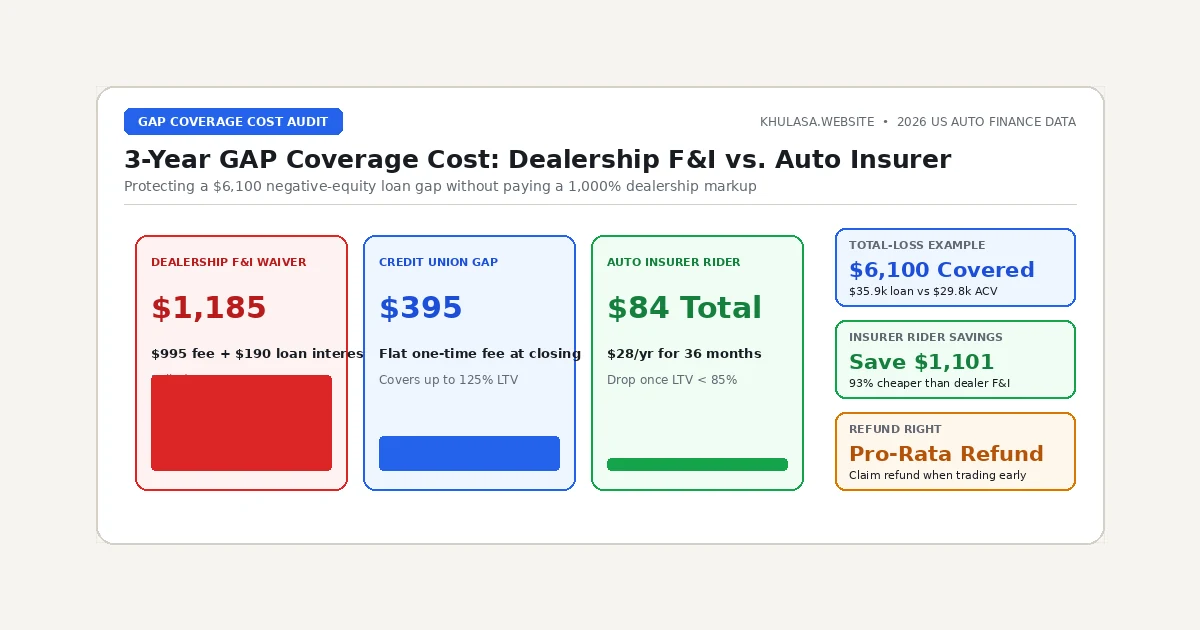
Eight months after financing a brand-new $38,000 SUV with $1,000 down and rolling $2,850 of state sales tax and registration fees into a 72-month loan, a reader in Atlanta was T-boned at a suburban intersection. Nobody was seriously hurt, but the frame was bent and her insurance carrier declared the crossover a total loss. She assumed her full-coverage collision policy would pay off her bank loan. It did not. By contract, standard personal auto insurance policies pay only Actual Cash Value (ACV), which is the depreciated market value of the used vehicle one second before the crash.
In Month 8, that SUV's Actual Cash Value sat at $31,400 (leaving a $30,400 check after her $1,000 collision deductible), while her 72-month loan payoff balance stood at $36,250. Without Guaranteed Asset Protection (GAP) coverage, her car was in a salvage yard and her lender sent a bill for the remaining $5,850.00 deficiency balance. As the Consumer Financial Protection Bureau (CFPB) GAP Insurance Guide and the National Association of Insurance Commissioners (NAIC) explain, GAP protection is essential on high-LTV loans, but buying it from a dealership finance desk is a $1,000 mistake.
The $995 Dealership F&I Markup vs. the $28/Year Auto Insurer Rider
The risk is very real. Dealership markups are even worse. Because the total-loss deficiency hazard hits low-down-payment buyers hard, F&I managers have turned standalone GAP waiver contracts into one of their highest-margin profit centers. The wholesale administrative cost of a dealership GAP waiver is roughly $180 to $240, yet dealers routinely price it at $895 to $1,295, and roll that $995 charge into your 60- or 72-month auto loan at 6.75% APR (where it costs $1,182 to $1,220 with interest).
Here is what the F&I office never mentions: major personal auto insurance carriers (Progressive, Travelers, Nationwide, American Family, Auto-Owners, Erie, and USAA/Allstate loan-lease payoff endorsements) offer Loan/Lease Payoff or GAP endorsements directly on your auto insurance policy for $20 to $45 per year ($1.75 to $3.75 per month), and credit unions sell flat-fee GAP waivers for $299 to $450.
Cost & Coverage Comparison Across All 3 GAP Sources
Before you sign a $995 GAP addendum in the dealership finance box, compare the three ways to buy GAP protection over the 24 to 36 months you actually remain underwater on the loan:
| GAP Coverage Source | Upfront / Annual Cost | Financed Interest Cost | Total Cost Over 30 Months Underwater | Covers Insurance Deductible? | Easy to Drop Once Equity Turns Positive? |
|---|---|---|---|---|---|
| 1. Auto Insurance Policy Rider (Loan/Lease Payoff Endorsement) |
$24 – $42 / year ($2–$3.50/mo) | $0.00 | $60 – $105 total | Usually No (Caps at 25% over ACV on some carriers) | Instant (Click remove in app at Month 24–30) |
| 2. Credit Union GAP Waiver (When financing via Credit Union) |
$299 – $450 flat fee | ~$45 if rolled in | $299 – $495 (minus pro-rata refund if canceled) | Often covers up to $1,000 deductible | Yes (Request pro-rata refund after break-even) |
| 3. Dealership F&I GAP Contract (Rolled into 72-Mo Loan @ 6.95%) |
$895 – $1,295 | +$212 interest | $1,107 – $1,507 (unless manually canceled for refund) | Usually covers up to $1,000 deductible | Requires written cancellation form & odometer statement |
The 4-Point Litmus Test: Do You Actually Need GAP Coverage?
You can determine in 30 seconds whether you need GAP coverage, or whether paying for GAP is 100% wasted money, by checking your loan structure in our Monthly Car Payment Calculator and Car Depreciation Calculator:
- You DO NOT need GAP if: You put 20% or more down (in cash and/or positive trade-in equity) on a 36-, 48-, or 60-month loan. With 20% down, your loan balance starts below 85% of MSRP, meaning your car's wholesale Actual Cash Value stays above your loan payoff from Day 1 to Day 1,800. If your car is totaled, a GAP policy pays $0.00 because there is no gap!
- You DO NOT need to buy extra GAP on most leases: Almost every captive automaker lease contract in the United States (Honda, Toyota/Lexus in most states, BMW, Ford, GM, Hyundai/Kia, Subaru/Chase) already includes a built-in GAP waiver inside the base lease contract via the acquisition fee. Never pay an F&I manager $895 for duplicate GAP on a lease that already waives deficiency balances in the contract text!
- You MUST carry GAP (via your insurer or credit union) if:
- You put less than 10% down and roll sales tax and fees into the loan.
- You finance for 72 or 84 months.
- You roll negative equity from a previous trade-in into the new loan (check your starting LTV in our Car Trade-In Value / Equity Calculator).
- You buy a fast-depreciating vehicle segment (such as a new EV or luxury sedan losing 20%+ per year).
How to Claim a $400–$650 Pro-Rata Refund on Dealership GAP You Already Bought
To be completely candid, most borrowers never realize they can get their money back. Already financed $995 for dealership GAP two years ago, or just traded in or paid off a car early? Here is a consumer right that dealerships rarely volunteer: in almost every US state (and explicitly codified under state insurance and motor-vehicle retail installment statutes in California, Texas, Colorado, New York, and others), **unearned GAP waiver fees and extended service contracts are refundable on a pro-rata basis** whenever you pay off your loan early, refinance, trade the vehicle in, or reach positive equity and cancel the coverage in writing.
If you paid $1,000 for a 72-month GAP contract and trade the vehicle in or refinance at Month 30, you have used only 41.7% of the contract term, entitling you to a ~$530 to $580 refund check (less a nominal $25–$50 cancellation fee where permitted). Contact the GAP administrator listed on your original F&I addendum with your payoff confirmation letter or odometer statement to claim your refund.
Why Auto Insurer 'Loan/Lease Payoff' Riders Cap Coverage at 25% of ACV
Before choosing between a $30/year auto insurance endorsement and a $395 credit union GAP waiver, check one crucial math detail: your starting Loan-to-Value (LTV) ratio. Standalone GAP waivers sold by credit unions (and dealerships) typically cover your loan balance up to 125% to 150% of the vehicle's MSRP or retail value and often reimburse up to $1,000 of your collision insurance deductible.
Auto insurance policy riders (called "Loan/Lease Payoff Coverage" at Progressive, Travelers, and Nationwide) usually cap their payout at 25% above the vehicle's Actual Cash Value at the time of the crash and exclude your collision deductible. If you put 0% to 10% down on a clean loan, a 25% ACV buffer ($7,500 on a $30,000 ACV car) is more than enough. However, if you rolled $6,000 of old negative equity into a new loan (starting at 125% LTV on Day 1), a credit union's $395 full GAP waiver is the safer choice.