
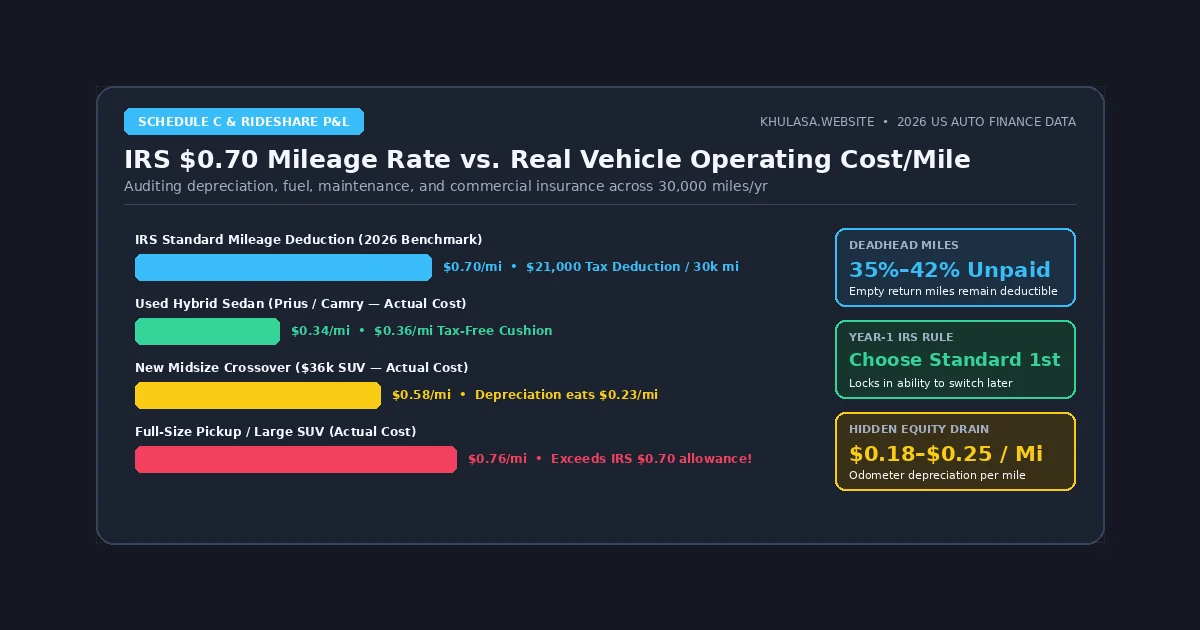
An Uber and DoorDash driver in Phoenix emailed me his year-end spreadsheet last winter after logging 28,000 miles in a two-year-old crossover. On Friday nights, he felt like he was printing cash. His app screen showed $240 in gross fares over eight hours, and he only spent $28 refilling the tank, leaving $212 in his checking account. Then reality arrived in the same week: a $1,120 bill for four tires and front brake pads, plus a trade-in appraisal showing his crossover had lost $5,600 in wholesale value from the extra odometer miles.
I see this accounting blind spot every tax season. Counting only the gas pump receipt ($0.11/mile) treats your tires, wheel bearings, transmission fluid, rideshare insurance endorsement, and per-mile depreciation as if they were free. You are not earning $26.50 an hour; you are liquidating your vehicle's equity into Friday night cash. By comparing your true operating ledger against official IRS Standard Mileage Rates and record-keeping rules in IRS Publication 463 (Travel, Gift, and Car Expenses), you can turn the tax code into a massive profit shield instead of a wealth trap.
What Is Actually Inside the IRS Standard Mileage Rate (~$0.70/Mile)?
Here is how the federal benchmark works. Every December, the Internal Revenue Service commissions independent fleet-economics firm Motus to calculate the national average cost of operating an automobile for business purposes (set at $0.70 per mile for standard business use). That $0.70 per-mile figure is not a tax credit paid to you in cash, it is a Schedule C tax deduction that reduces your taxable net business income.
More importantly, under IRS Notice rules, roughly $0.30 to $0.33 of every $0.70 business mile is the IRS's statutory depreciation allowance, with the remaining ~$0.38/mile representing fuel, maintenance, tires, insurance, and registration. Whether you pocket a profit or suffer a loss relative to that $0.70/mile benchmark depends entirely on the vehicle you choose to drive.
Profit & Loss Per-Mile Audit Across 4 Business & Gig-Economy Vehicles (25,000 Miles/Year)
Let's use our Cost Per Mile Calculator to audit four real vehicles driven 25,000 business/gig miles per year with gasoline at $3.50/gallon, comparing their actual cash + depreciation cost per mile against a $0.70/mile IRS Schedule C deduction (assuming a 24% combined federal + self-employment + state marginal tax impact):
| Cost Component (at 25,000 Miles/Year) | 4-Yr-Old Used Hybrid (2022 Toyota Prius, $19k, 50 MPG) | 3-Yr-Old Used Gas Sedan (2023 Camry/Civic, $21k, 33 MPG) | Brand-New Gas Crossover (2026 RAV4/CR-V, $35k, 28 MPG) | New 3-Row SUV / UberXL ($48k SUV, 21 MPG) |
|---|---|---|---|---|
| 1. Fuel Cost per Mile | $0.0700 / mi | $0.1061 / mi | $0.1250 / mi | $0.1667 / mi |
| 2. Maintenance, Tires & Brakes / Mi | $0.0640 / mi | $0.0720 / mi | $0.0680 / mi | $0.0920 / mi |
| 3. Insurance + Rideshare Endorsement / Mi | $0.0760 / mi ($1,900/yr) | $0.0800 / mi ($2,000/yr) | $0.0880 / mi ($2,200/yr) | $0.1040 / mi ($2,600/yr) |
| 4. High-Mileage Depreciation / Mi | $0.0960 / mi ($2,400/yr) | $0.1160 / mi ($2,900/yr) | $0.2160 / mi ($5,400/yr) | $0.3120 / mi ($7,800/yr) |
| True Total Cost per Mile | $0.3060 / mi | $0.3741 / mi | $0.4970 / mi | $0.6747 / mi |
| Annual True Vehicle Expense (25k Mi) | $7,650 / yr | $9,353 / yr | $12,425 / yr | $16,868 / yr |
| IRS Deduction Claimed (@ $0.70/Mi) | $17,500 ($9,850 tax-free spread!) | $17,500 ($8,147 tax-free spread!) | $17,500 ($5,075 spread) | $17,500 ($632 spread) |
Why Driving a Brand-New Car for High-Mileage Delivery Is a Wealth Trap
Compare Column 1 (the 4-year-old $19,000 Toyota Prius) against Column 3 (the brand-new $35,000 compact SUV) in the table above. Over 25,000 miles of annual driving, the new SUV costs $12,425 per year ($0.4970/mile) while the used Prius costs $7,650 per year ($0.3060/mile), putting $4,775 more cash profit into the Prius driver's pocket every single year for the exact same trips!
Even better, look at the tax math: both drivers legally deduct the exact same $17,500 (25,000 miles × $0.70/mile) on IRS Schedule C. Because the Prius driver's actual economic cost was only $7,650, the $9,850 difference between the $17,500 IRS deduction and their $7,650 actual cost shields $9,850 of their labor income from both federal income tax and the 15.3% Self-Employment (SECA) tax, generating an extra $2,360+ in annual tax savings.
IRS Standard Mileage Method vs. Actual Expense Method: The First-Year Rule
Self-employed 1099 contractors and rideshare drivers have a critical tax election to make in the very first tax year a vehicle is placed in service for business:
- To preserve the right to use the IRS Standard Mileage Rate in future years, you MUST choose the Standard Mileage Rate in Year 1 that the vehicle is used for business. If you select the Actual Expense method (or claim Section 179 / MACRS bonus depreciation) in Year 1, IRS rules permanently lock that vehicle into the Actual Expense method for the rest of the time you own it!
- Which method wins? Run your exact numbers in our Cost Per Mile Calculator. If your vehicle's true cost per mile (including loan interest and registration) is below $0.70/mile (which is almost always true for hybrids, economy sedans, and cars driven 15,000+ miles/year), the IRS Standard Mileage Rate wins hands down, plus you can still deduct business parking fees, highway tolls, and the business-use percentage of your auto loan interest and state personal property car taxes on top of the per-mile rate!
What GPS Mileage Log Records Survive an IRS Schedule C Audit?
If your Schedule C return claims $14,000 to $21,000 in business vehicle deductions and gets selected for an IRS correspondence examination, the auditor will not accept your rideshare app's summary payout PDF alone. Rideshare platform summaries frequently count only "active passenger/delivery miles" (Period 2 and Period 3) while omitting the 35% to 42% of deductible business miles spent driving between drop-offs or waiting for dispatches (Period 1).
Under IRS Publication 463 substantiation rules, you must maintain a contemporaneous log recording: (1) the exact date and business purpose of each shift or trip, (2) the starting and ending odometer readings on January 1 and December 31 to establish total annual vehicle mileage, and (3) the exact business miles logged per trip. Run an automated GPS mileage tracker alongside two timestamped smartphone photos of your dashboard odometer on New Year's Day and New Year's Eve.