
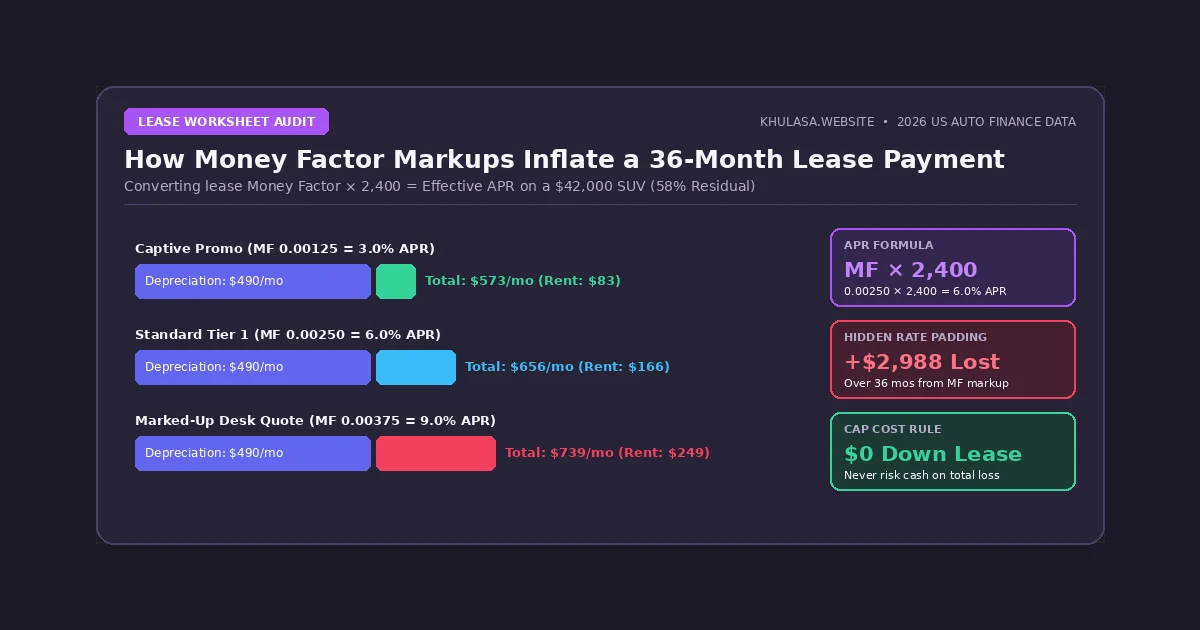
Nine out of ten drivers who finance a car can recite their interest rate to the tenth of a percent. Yet when I review 36-month lease agreements for readers driving a $46,000 BMW X3 or Honda Prologue, almost nobody can name the financing rate embedded inside their $539 monthly payment. That blind spot exists by design. Under the federal Consumer Leasing Act (Regulation M) and consumer guidance from the Consumer Financial Protection Bureau (CFPB), dealerships must disclose the total dollar "Rent Charge" over the lease term, but they are not required to print an Annual Percentage Rate (APR) anywhere on the lease contract.
Instead, lease financing costs hide inside a five-decimal fraction called the Money Factor (or Lease Factor), such as 0.00285. Dealers know this trick well. Because very few shoppers have an intuitive feel for whether 0.00285 is cheap or expensive, dealership F&I offices routinely mark up the bank's wholesale Money Factor to pack thousands of dollars in hidden interest profit into a lease.
The Exact Three-Part Formula Behind Every Monthly Car Lease Payment
Once you know the three core variables on a dealer's lease worksheet, Adjusted Capitalized Cost (the negotiated price of the car plus bank acquisition fee, minus any rebates or cap-cost reduction), Residual Value (the preset wholesale value of the car at the end of the lease, set by the leasing bank as a percentage of full MSRP), and the Money Factor (MF), you can calculate a lease payment to the exact penny on the back of an envelope:
- Part 1, Monthly Depreciation Charge:
Monthly Depreciation = (Adjusted Cap Cost − Residual Value) ÷ Lease Term in Months - Part 2, Monthly Rent (Finance) Charge:
Monthly Rent Charge = (Adjusted Cap Cost + Residual Value) × Money Factor
(Why are Cap Cost and Residual Value added together? Because during a lease your balance starts at the Cap Cost and ends at the Residual Value; averaging the two approximates the average tied-up capital, and the Money Factor already divides the annual rate by 24, which is 12 months × 2!) - Part 3, Pre-Tax Base Monthly Lease Payment:
Base Monthly Payment = Monthly Depreciation + Monthly Rent Charge
To convert any Money Factor into its equivalent Annual Percentage Rate (APR), multiply by 2,400:
Equivalent APR (%) = Money Factor × 2,400
Worked Audit: Tearing Down a 36-Month Lease on a $42,000 SUV
Suppose you are leasing a 2026 Hyundai Tucson Limited or Mazda CX-50 Turbo with a $42,000 MSRP for 36 months at 12,000 miles/year. The captive finance company sets the 36-month residual at 58% of MSRP ($24,360.00) and offers a Tier-1 base Money Factor of 0.00225 (5.40% APR). Look at how negotiating the selling price and spotting a dealer Money Factor markup changes the numbers:
| Lease Worksheet Line Item | Deal A: Sticker Price + Marked-Up MF (0.00315 = 7.56% APR) | Deal B: $2,500 Negotiated Discount + Base MF (0.00225 = 5.40% APR) | Dollar Savings in Deal B |
|---|---|---|---|
| Full Window Sticker (MSRP) | $42,000.00 | $42,000.00 | Same Vehicle |
| Negotiated Selling Price + $650 Acquisition Fee | $42,650.00 (No discount) | $40,150.00 ($2,500 off MSRP) | −$2,500.00 Cap Cost |
| 36-Month Residual Value (58% of MSRP) | $24,360.00 | $24,360.00 | Fixed by Bank |
| 1. Monthly Depreciation Charge | $508.06 / mo | $438.61 / mo | −$69.45 / mo |
| 2. Monthly Rent (Finance) Charge | $211.08 / mo (at 0.00315 MF) | $145.15 / mo (at 0.00225 MF) | −$65.93 / mo |
| Total Pre-Tax Monthly Payment | $719.14 / mo | $583.76 / mo | −$135.38 / mo |
| 36-Month Cumulative Lease Cost | $25,889.04 | $21,015.36 | $4,873.68 Saved! |
Look at that result: simply knowing that you can negotiate the Capitalized Cost on a lease exactly like a purchase ($2,500 off MSRP) and insisting on the captive lender's Tier-1 base Money Factor (`0.00225` instead of the dealer's marked-up `0.00315`) saves $135.38 every single month, or $4,873.68 over the 36-month contract!
Why Putting $4,000 Down on a Lease Is a Financial Hazard
National TV commercials love advertising "$299/month for 36 months with $4,499 due at signing." That $4,499 upfront cash is mostly a Capitalized Cost Reduction, a down payment that prepays a chunk of the lease depreciation up front to make the monthly payment look artificially low.
Never put big cash down on a lease. When I review F&I worksheets, this is the first line I cross out. Unlike buying a car, putting $4,000 cash down on a lease exposes you to an unrecoverable loss if the vehicle is wrecked or stolen. Here is why: on a lease, the leasing bank (not you) is the legal owner on the title, and nearly all US lease contracts include automatic GAP waiver coverage. If you sign a zero-down lease and a distracted driver totals your car 60 days later, your auto insurance pays the leasing bank the car's market value, the lease's built-in GAP waiver absorbs any remaining contract shortfall, and you walk away having spent only two monthly payments.
If you paid a $4,000 Cap-Cost Reduction at signing and the exact same crash happens 60 days later, the insurance company still pays the bank the vehicle's market value to close the lease, and your $4,000 upfront cash down payment is gone forever. You get $0 back, and you have no car. When comparing a lease against a purchase in our Lease vs Buy Calculator, always ask the dealer to quote the lease with $0 Cap-Cost Reduction (paying only first month's payment, registration fees, and bank acquisition fee at signing) and keep your $4,000 safely in a 4.5% high-yield savings account to draw down monthly.
How to Check Whether Your Lease-End Buyout Option Is a Bargain or a Lemon
Sixty days before your 36-month lease expires, you face a three-way fork in the road: pay the $395–$495 disposition fee and return the car, trade or sell the car if it has positive equity, or buy the car for the contract's fixed Residual Value. Run your vehicle's original MSRP and real-world market depreciation through our Car Depreciation Calculator and get an instant cash appraisal from CarMax or Carvana:
- If wholesale market value is $23,500 and your contract residual buyout is $19,800: You have +$3,700 in positive lease equity! Never just hand those keys back to the bank for free, either buy the car out below market value or trade it in to capture the $3,700 credit.
- If wholesale market value is $18,000 and your contract residual buyout is $24,500 (common on EVs and luxury sedans with inflated factory residuals): The bank guessed wrong and absorbed a $6,500 depreciation hit on your behalf. Happily pay the $395 disposition fee, hand the keys back, and walk away from their $6,500 loss.
How Multiple Security Deposits (MSDs) Legally Buy Down Your Lease Rate
Several luxury and mainstream captive lenders (including BMW Financial Services, Toyota/Lexus Financial Services in eligible states, and Mercedes-Benz Financial) allow lessees to place Multiple Security Deposits (MSDs) at lease signing. Unlike a Capitalized Cost Reduction down payment, security deposits are 100% refundable at the end of the lease and are never forfeited if the car is totaled or stolen.
Each refundable security deposit (typically rounded to the nearest $50 above your base monthly payment, up to 7 or 9 deposits) reduces your lease Money Factor by a fixed step such as 0.00006 or 0.00007. On a $50,000 lease, placing $3,850 in refundable MSDs can trim your effective APR by 1.00% to 1.25%, saving $42 a month ($1,512 over 36 months) on money you get back in full when you turn in the keys. That represents a guaranteed, tax-free annual return of more than 13% on your deposit cash.