
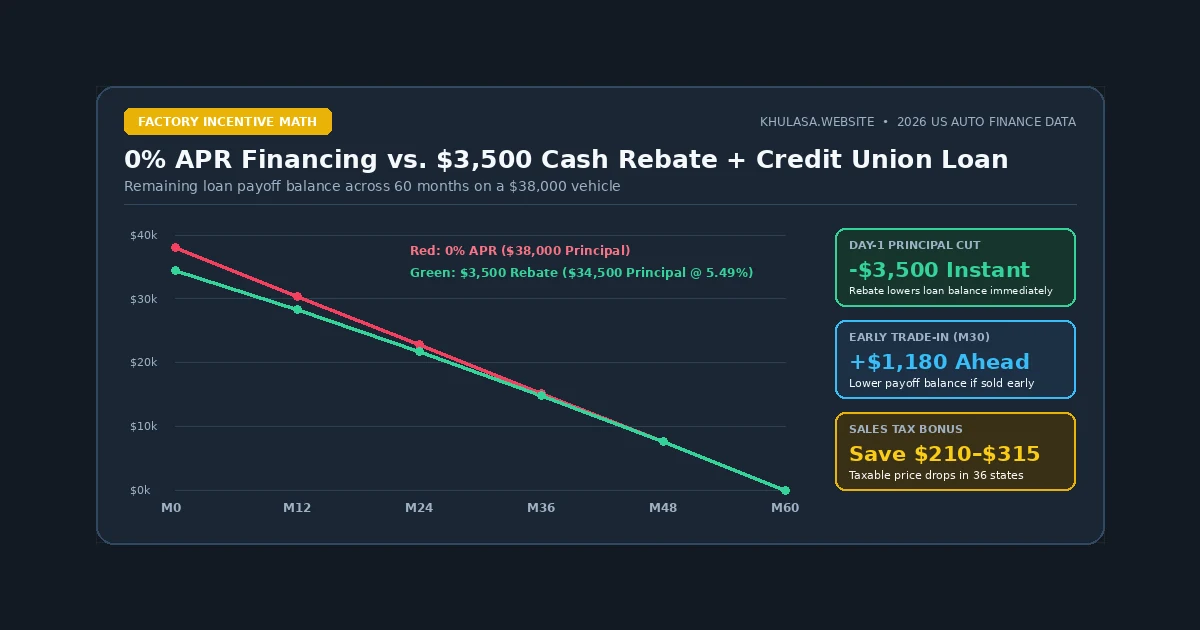
Does a 0% APR financing promotion really beat a $3,500 or $4,000 factory cash rebate when you run the full amortization schedule? Every Memorial Day, Labor Day, and December clearance event, automakers plaster "0% APR for 60 Months OR $4,000 Customer Bonus Cash!" across television screens.
Zero percent interest triggers a powerful psychological reflex. Nobody likes paying interest to a bank, so shoppers instinctively grab the 0% APR banner. Read the 8-point legal disclosure at the bottom of the screen twice: "Customer Bonus Cash cannot be combined with special APR financing through the manufacturer's captive lender." As the Consumer Financial Protection Bureau (CFPB) and the Federal Trade Commission (FTC) note in their auto-financing guides, choosing 0% APR is never free. Its upfront price tag is the $4,000 cash discount you just forfeited.
How to Pit 0% APR Head-to-Head Against a Cash Rebate in 60 Seconds
Because a factory cash rebate functions as an instant principal reduction on Day 1 while promotional APR reduces the interest rate applied to a larger principal balance over 48 or 60 months, you can compare the two offers directly by opening two tabs of our Car Loan Calculator:
- Option A (0% APR Promotional Financing): You finance the full net purchase price (after your own cash down payment) at
0.00% APR, and your total cost equals the exact principal borrowed. - Option B (Take the Cash Rebate + Outside Credit Union Loan): You apply the manufacturer's cash rebate directly to your Down Payment field (reducing the principal borrowed by $3,500) and finance the smaller balance at your credit union's market APR (for example,
5.95% APR).
Worked Break-Even Audit on a $38,000 Pickup or SUV ($3,000 Down / 60 Months)
Suppose you are buying a $38,000 vehicle with $3,000 of your own cash down (leaving $35,000 before rebates) over a 60-month term. The manufacturer offers either 0.0% APR for 60 months, 1.9% APR for 60 months, or a $4,000 Customer Cash Rebate (which you can pair with a 5.85% APR pre-approved loan from your local credit union). Let's run all three options side by side:
| Financing Metric (60-Month Term) | Option 1: 0.0% APR Promo (Forfeit $4,000 Rebate) | Option 2: 1.9% APR Promo + $1,000 Partial Rebate | Option 3: Take $4,000 Cash Rebate + 5.85% Credit Union Loan |
|---|---|---|---|
| Vehicle Price After $3,000 Cash Down | $35,000.00 | $35,000.00 | $35,000.00 |
| Less Manufacturer Cash Rebate | $0.00 | −$1,000.00 | −$4,000.00 |
| Net Loan Principal Financed | $35,000.00 | $34,000.00 | $31,000.00 |
| Monthly Payment (60 Months) | $583.33 / mo | $594.46 / mo | $597.18 / mo |
| Total Interest Paid Over 60 Months | $0.00 | $1,667.47 | $4,830.89 |
| Total 60-Month Loan Cost (if held full 5 yrs) | $35,000.00 (Wins by $831 at Month 60) | $35,667.47 | $35,830.89 |
| Remaining Loan Payoff at Month 30 (2.5 Yrs) | $17,500.00 | $17,403.12 | $16,608.45 (Rebate wins by $892!) |
The Hidden Twist: Why the Cash Rebate Beats 0% APR If You Pay Off Early or Trade In at Year 3
Here is the catch most shoppers miss. Look closely at the bottom two rows of the table above. If you hold the loan for every single one of the 60 months and never make an extra principal payment, the 0.0% APR offer ($35,000 total) beats the $4,000 rebate + 5.85% loan ($35,830.89 total) by $830.89 over five years.
Now look at the final row, Remaining Loan Payoff at Month 30:
- Under the 0.0% APR loan, your starting principal was $35,000, so halfway through the loan (after paying $17,500 over 30 months), you still owe $17,500.00.
- Under the $4,000 Cash Rebate + 5.85% loan, your starting principal dropped to $31,000 on Day 1! Halfway through the loan (after paying $17,915 over 30 months), your remaining loan payoff is only $16,608.45.
If your car is totaled in an accident in Year 2, or if you decide to trade the vehicle in after 30 or 36 months, or if you use a tax refund or work bonus to pay off the loan early in Year 3, taking the $4,000 upfront cash rebate leaves you nearly $900 to $1,800 richer than the 0% APR borrower, because you captured 100% of the $4,000 principal discount on Day 1 while cutting off the 5.85% interest clock two years early!
Quick Rule of Thumb: The "Rebate-to-Price Percentage" Test
When comparing a 0% APR 60-month offer against a cash rebate and a ~6.0% credit union loan, compare the cash rebate as a percentage of the amount you plan to finance:
- If the Cash Rebate is LESS than 13.5% of the loan amount (e.g. $2,000 rebate on a $30,000 loan = 6.7%) and you plan to keep the loan for the full 60 months: Take the 0% APR.
- If the Cash Rebate is MORE than 14% of the loan amount (e.g. $3,500 rebate on a $22,000 loan = 15.9%) OR you plan to pay the loan off within 24 to 36 months: Take the Cash Rebate and pay the credit union loan off early!
Always run both numbers side by side in our Car Loan Calculator before stepping into the F&I office, and read our companion article on how walking in with a credit union pre-approval letter protects you from dealer rate markups.
How State Sales Tax Laws Give Cash Rebates an Extra $240 to $380 Edge
There is one more hidden variable that tips close comparisons in favor of the factory cash rebate in a handful of states: how your state taxes manufacturer rebates. In the majority of US states (approximately 38 states, including California, New York, Illinois, Ohio, and Michigan), state revenue codes tax a manufacturer rebate as if the automaker handed you cash that you then used as a down payment, meaning you pay sales tax on the pre-rebate price.
However, in states that treat manufacturer-to-dealer incentives or customer rebates coupled with dealer discounts as a direct reduction in the taxable selling price (such as Texas under Comptroller motor-vehicle rules when structured as a price reduction, and several states with lower tax bases), reducing the contract selling price by $4,000 also saves $250 to $340 in upfront sales tax. Always check both the 0% APR column and the Rebate column on an Out-the-Door basis in our Monthly Car Payment Calculator.