
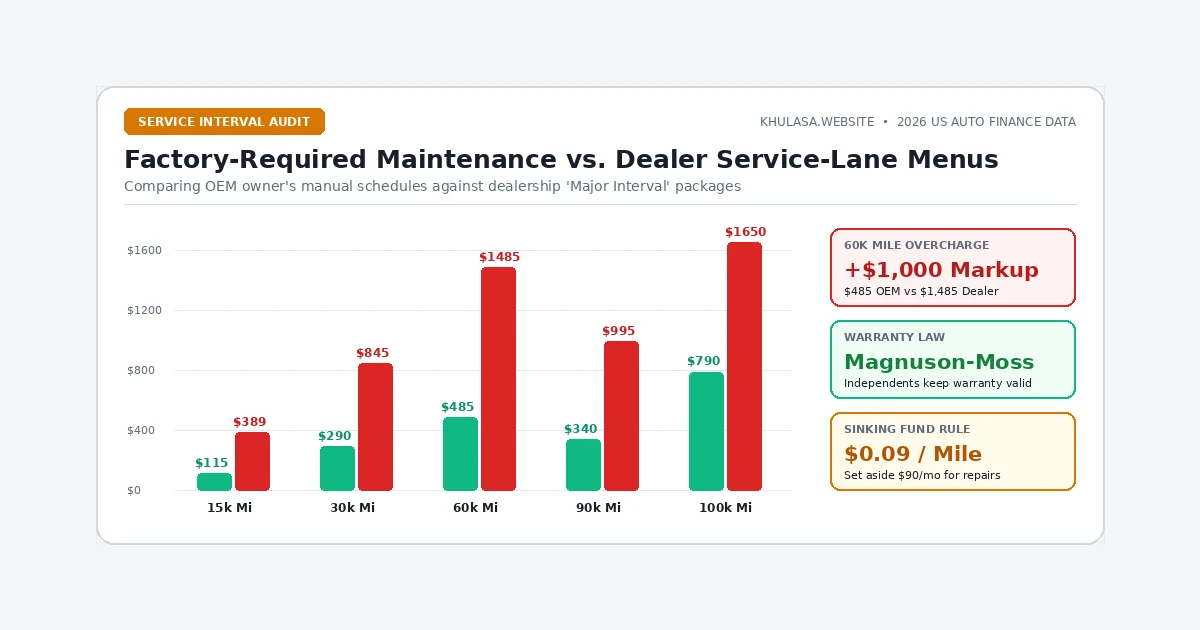
Three weeks ago, a reader in Columbus texted me a photo of a laminated placard from his dealership service lane titled "60,000-Mile Platinum Factory Recommended Service: $1,495.00." His 2022 Subaru Outback had 59,800 miles on the odometer and ran without a single warning light. Service advisors are almost always paid on a base-plus-commission structure tied to customer-pay parts and labor gross profit. I see this exact menu upsell every week.
Read the fine print at the bottom of that laminated card twice: "Dealer-recommended maintenance schedule tailored for local driving conditions." That sentence means the package was invented by the dealership's fixed-operations director, not by the automotive engineers who designed the powertrain. Under the federal Magnuson-Moss Warranty Act enforced by the Federal Trade Commission (FTC) and consumer guidance on FTC Auto Warranties and Service Contracts, a dealer cannot void your factory warranty for declining dealer-invented flushes or having routine maintenance performed at an independent shop. When you price only the items listed in your factory glovebox manual and check open safety recalls for free at NHTSA.gov/recalls, that $1,495 bill shrinks to $480 to $690.
Why Maintenance Costs Arrive in Three Distinct Mileage Cliffs
Early ownership feels deceptively cheap. During the first 25,000 miles of a vehicle's life, routine maintenance consists almost entirely of full-synthetic oil changes, oil filters, tire rotations, and cabin air filters, costing roughly $180 to $280 per year. As mileage accumulates, however, hydraulic fluids, friction linings, elastomers, and ignition components reach the end of their engineered service life in three distinct waves: the 30,000-mile fluid & filter check, the 60,000-mile drivetrain & wear-item cliff, and the 100,000-mile ignition, cooling & suspension overhaul.
Factory Manual vs. Dealership "Package" Menu Across 30k, 60k, and 100k Miles
Use the audit table below to see what the engineers who built your vehicle actually require at each major milestone, what independent repair shops versus dealerships charge in 2026, and which high-margin chemical flushes you should cross off the repair order before signing:
| Mileage Milestone | Legitimate Factory-Required Services | Bogus Dealer Menu Upsells to Decline | Dealer "Package" Quote | Fair Independent Shop Cost (Required Only) |
|---|---|---|---|---|
| 30,000 Miles (~Year 2.5) |
Synthetic oil & filter, tire rotation, engine air filter, cabin air filter, DOT 3/4 brake fluid exchange (every 2–3 yrs), multi-point brake/tire inspection | Fuel injector chemical flush ($219), throttle body decarbonization ($189), engine oil chemical additive ($49), power steering flush on electric-rack cars | $680 – $950 | $260 – $380 ($160 if DIY air/cabin filters) |
| 60,000 Miles (~Year 5) |
All 30k items + automatic/CVT transmission fluid drain-and-fill, AWD rear differential & transfer case gear oil, plus typical wear: front/rear brake pads & rotors + 4 tires + 12V AGM battery | Pressurized transmission chemical flush machine (use simple drain-and-fill instead), AC evaporator foam sanitizer ($179), fuel system induction kit ($289) | $1,350 – $1,850 (+$1,800 w/ tires & brakes) |
$550 – $780 (Fluids/service) +$1,550 (Tires, brakes & battery) |
| 90,000 – 105,000 Miles (~Year 8) |
Iridium spark plugs (100k–120k mi), engine & inverter coolant replacement, serpentine accessory drive belt, transmission & diff fluids, plus suspension struts/control-arm bushings as needed | Engine crankcase sludge flush ($199), radiator stop-leak additives, preventive fuel pump replacement | $1,800 – $2,600 (+$1,400 suspension/belts) |
$850 – $1,250 (+$650 if timing belt engine) |
Four Service-Lane Upsells That Waste Hundreds of Dollars
1. The $95 Cabin & Engine Air Filter Labor Trap
Dealers know this trick well. At nearly every 15,000- or 30,000-mile oil change, a service technician will text you a photo of a dusty pleated paper cabin air filter and quote $89.95 for the cabin filter and $69.95 for the engine air filter ($160 total). On 90% of Toyota, Honda, Subaru, Hyundai, and Ford vehicles, the cabin air filter sits directly behind the glovebox door (which unclips by hand in 45 seconds without a single screwdriver) and the engine air box opens with two metal spring clips. Buying OEM-grade Denso, Wix, or Mann filters for $16 each ($32 total) and swapping them yourself in five minutes saves $128 every single year.
2. Pressurized Chemical Fuel-Injector Flushes on Healthy Engines
Unless your vehicle has a diagnosed misfire, rough idle, or direct-injection intake valve carbon buildup confirmed by a borescope at 80,000+ miles, paying $229 every 30,000 miles for a pressurized solvent "fuel system induction service" is pure margin for the shop. Fuels certified to TOP TIER™ detergent gasoline standards (sold at Costco, Chevron, Shell, Mobil, QuikTrip, and Cenex) already contain detergent additive packages that keep port and direct injectors clean during normal driving.
3. Transmission "Power Flush" vs. Drain-and-Fill
When servicing an automatic or CVT transmission at 50,000 to 60,000 miles, always ask for a gravity drain-and-fill using the automaker's exact OEM fluid specification (such as Toyota WS, Honda HCF-2, or ZF Lifeguard) rather than a high-pressure chemical flushing machine with universal fluid plus modifiers. A drain-and-fill refreshes the fluid safely without dislodging clutch debris into delicate valve-body solenoids.
4. The Timing Belt Exception (Honda 3.5L V6 & Older Interference Engines)
While the vast majority of modern four-cylinder and V6 engines use metal timing chains designed to last the life of the engine, several popular vehicles, most notably Honda and Acura 3.5-liter V6 models (Pilot, Odyssey, Passport, Ridgeline, MDX), still use a rubber-composite toothed timing belt that must be replaced every 100,000 to 105,000 miles or 7 years alongside the water pump and hydraulic tensioner ($950 to $1,450). Never skip a scheduled timing belt replacement: on an interference engine, a snapped timing belt causes the pistons to strike the open valves, destroying the engine instantaneously.
How to Build a Stress-Free Monthly Maintenance Sinking Fund
Instead of treating a $1,000 set of tires at 45,000 miles or a $750 brake and fluid visit at 60,000 miles as an "unexpected emergency," enter your fixed annual service costs ($300–$450/year) and variable wear costs ($0.04–$0.06/mile) into our Car Maintenance Cost Calculator. Transfer one-twelfth of the annual projection ($65 to $95/month) into an automated savings sub-account on the first of every month, and check our Cost Per Mile Calculator to see how preventative maintenance protects your long-term vehicle equity.
How the Magnuson-Moss Warranty Act Protects Independent and DIY Maintenance
Service advisors frequently imply that skipping the dealership's 30,000- or 60,000-mile package or visiting an independent ASE-certified mechanic will jeopardize your 5-year/60,000-mile powertrain warranty. That claim violates federal law. Under the Magnuson-Moss Warranty Act (15 U.S.C. § 2302(c)), an automaker cannot condition warranty coverage on using branded dealer service departments unless the manufacturer provides those parts and labor completely free of charge.
To keep your warranty 100% bulletproof when using an independent shop or changing your own oil and filters, maintain a simple folder (plus smartphone photos) containing dated receipts that show the vehicle's odometer mileage and the exact OEM-specification fluid or filter part numbers installed.