
Ask any first-winter EV owner in Minnesota, Michigan, Upstate New York, or New England what surprised them most about switching from gasoline to electric, and they won't mention public chargers—they will tell you about the morning in January when their "300-mile" crossover showed 185 miles of real highway range at 15°F.
Wait—don't gasoline cars also lose efficiency in winter? Yes: according to U.S. Department of Energy cold-weather testing, conventional gasoline cars lose 15% to 24% of their fuel economy on short winter trips due to denser cold air, higher drivetrain oil viscosity, and winter-blend gasoline. Why, then, do electric vehicles lose 25% to 41% of their range at 20°F as documented in AAA laboratory dynamometer studies?
The answer comes down to a fundamental thermodynamic irony: internal combustion engines are so inefficient that they produce "free" cabin heat, whereas electric motors are so efficient (90%+) that every BTU of cabin and battery warmth must be stolen directly from your driving battery. Let's examine how much range a Heat Pump actually saves compared to a resistive PTC heater, and how winter kWh consumption changes your math in our EV vs. Gas Total Cost Calculator.
Why Combustion Cars Have "Free" Heat and EVs Don't
A gasoline engine has a thermal efficiency of roughly 25% to 35%. That means out of every $40 tank of gas you burn, $26 to $30 worth of energy is wasted purely as heat radiating into the engine block and exhaust pipe. In July, your radiator fan works overtime to dump that waste heat into the atmosphere. In January, flipping on your cabin heater simply opens a valve that routes 195°F engine coolant through a small radiator core behind your dashboard. Warming the cabin in a gas car costs virtually zero extra fuel.
An electric drivetrain wastes almost no heat. When it is 15°F outside, an EV has to spend high-voltage battery power on three simultaneous winter penalties:
- Sluggish Lithium-Ion Electrolyte Chemistry: Below 40°F, the liquid electrolyte inside lithium-ion cells becomes viscous, slowing the diffusion of lithium ions into the graphite anode. Not only does the Battery Management System (BMS) temporarily lock out regenerative braking on a cold-soaked battery (to prevent metallic lithium plating), it also runs a coolant heater to warm the 1,000-pound battery pack itself.
- Cabin Heating Load (1.5 kW to 6.0 kW Continuous Draw): Heating a glass-roofed cabin from 15°F to 70°F while freezing wind strips heat off the windshield at 70 mph requires substantial continuous wattage.
- 12% Denser Winter Air: Cold air at 15°F is roughly 11.5% denser than warm air at 75°F, increasing aerodynamic drag on the highway regardless of what powers the wheels.
Heat Pump vs. Resistive (PTC) Heater: The Technology That Saves 12%–18% Range
How an EV heats its cabin and battery makes an enormous difference between 15°F and 45°F. Older EVs and some entry-level trims use a Positive Temperature Coefficient (PTC) resistive heater—essentially a giant 5,000-watt hair dryer or space heater element. Because a resistive heater converts electricity directly into heat at a 1-to-1 ratio, its Coefficient of Performance (COP) cannot exceed 1.0 (1 kWh of battery power yields at most 1 kWh of heat).
Modern cold-climate EVs use a vapor-compression Heat Pump paired with a multi-port octovalve or coolant manifold. Instead of creating heat from scratch via electrical resistance, a heat pump acts like an air conditioner running in reverse—scavenging ambient thermal energy from the outside air, Plus the waste heat from the electric drive motors, power inverter, and battery pack, and compressing that refrigerant to warm the cabin. Between 20°F and 45°F, an automotive heat pump achieves a COP of 2.2 to 3.2—delivering up to three times as much cabin heat per kilowatt-hour drawn from the battery.
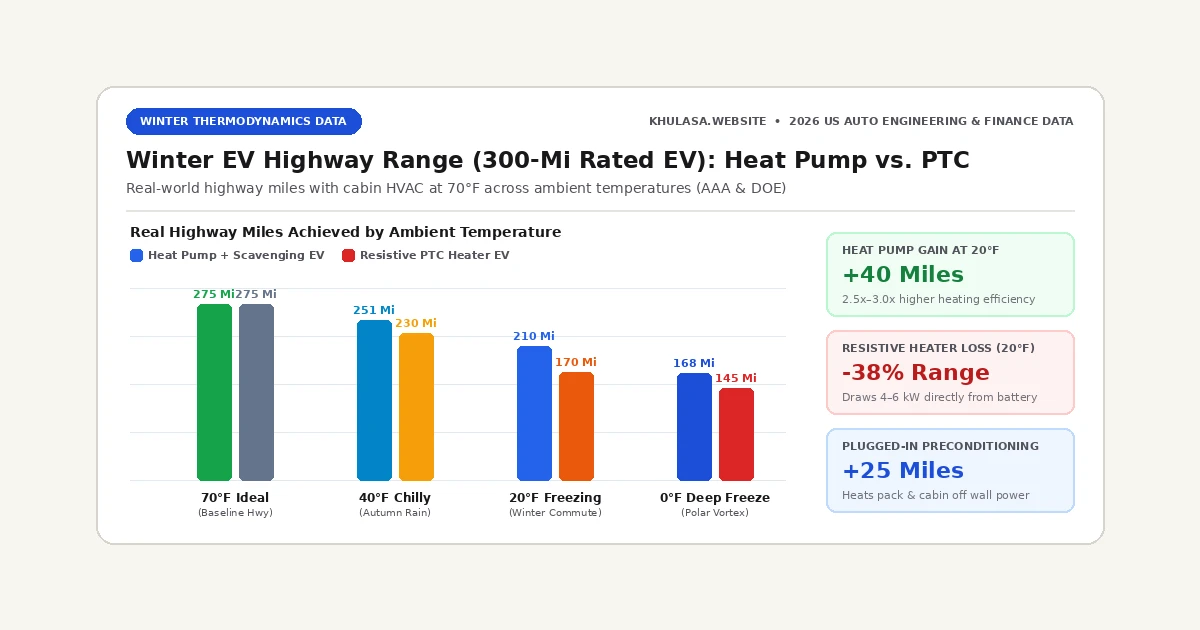
| Ambient Temperature (HVAC Set to 70°F) | EV With Resistive PTC Heater Range Loss | EV With Heat Pump + Thermal Scavenging Range Loss | Real Highway Range on a 300-Mile Rated EV (PTC vs. Heat Pump) | Winter Cost Per Mile Impact (@ $0.16/kWh Home Rate) |
|---|---|---|---|---|
| 70°F (Ideal EPA Test Conditions) | 0% (Baseline) | 0% (Baseline) | 275 Mi vs. 275 Mi (Real 70-mph Hwy) | $0.044 / mi vs. $0.044 / mi |
| 40°F (Chilly Autumn / Rain) | -14% to -18% | -7% to -10% | 230 Mi vs. 251 Mi (+21 Mi advantage) | $0.052 / mi vs. $0.048 / mi |
| 20°F (Typical Northern Winter Morning) | -35% to -41% | -21% to -26% | 170 Mi vs. 210 Mi (+40 Mi advantage) | $0.071 / mi vs. $0.058 / mi |
| 0°F to -10°F (Polar Vortex / Deep Freeze) | -44% to -50% | -36% to -42% | 145 Mi vs. 168 Mi (+23 Mi advantage) | $0.082 / mi vs. $0.072 / mi |
Notice what happens at 0°F and below: even a heat pump loses some of its advantage in extreme sub-zero cold because scavenging heat from -5°F air becomes thermodynamically difficult, forcing the system to blend in supplemental resistive heating or deliberately run the electric drive motor windings inefficiently to generate waste heat.
Why Five 4-Mile Winter Errands Hurt Worse Than One 150-Mile Highway Trip
The worst-case scenario for any electric vehicle in winter isn't a continuous 150-mile highway drive—it is making five separate 4-mile errands spaced two hours apart. Every time the cabin and battery pack cool back down to 15°F in a store parking lot, the heater has to pull 5 to 7 kW at maximum blast for the first 12 minutes just to reheat the cabin air, glass, and battery coolant loop. On short stop-and-go winter hops, energy consumption can double from 280 Wh/mile in summer to 550+ Wh/mile in January.
4 Winter Habits That Recover 30 to 45 Miles of Freezing-Weather Range
- Precondition for 20 Minutes While Still Plugged Into Your Home Wall Charger: This is the #1 winter superpower of an EV. Use your phone app or scheduled departure timer to warm both the cabin and the high-voltage battery pack 20 minutes before you leave in the morning while the car is still drawing power from your 240V house circuit. You leave the driveway with a warm 65°F battery (giving you full regenerative braking immediately) and a toasty cabin without spending 1% of your onboard battery range.
- Use Heated Seats and the Heated Steering Wheel Instead of Roasting the Whole Cabin: Conductive heat applied directly to your back and hands consumes only 45 to 75 watts per seat—roughly 1/40th of the power required to heat the entire cabin air volume to 74°F. Setting the cabin air temperature to 66°F with Level 2 seat and steering wheel heat cuts HVAC battery draw by nearly 35%.
- Check Your Cold Tire Pressure When Temperatures Drop Below Freezing: As we proved in our tire pressure and aerodynamic drag study, a 40°F drop in temperature from summer to winter lowers your tire pressure by 4 PSI, adding unnecessary rolling resistance on top of cold-battery losses.
- Charge at DC Fast Chargers Immediately After Driving (Not Next Morning): If you are staying at a hotel on a winter road trip, plug into the DC fast charger the night you arrive while the battery pack is still warm from highway driving. Plugging a cold-soaked 15°F battery into a fast charger the next morning will result in painfully slow 25–40 kW charging speeds for the first 25 minutes while the pack heats itself up. For long-term battery health data, read our 100,000-mile EV battery degradation study.