
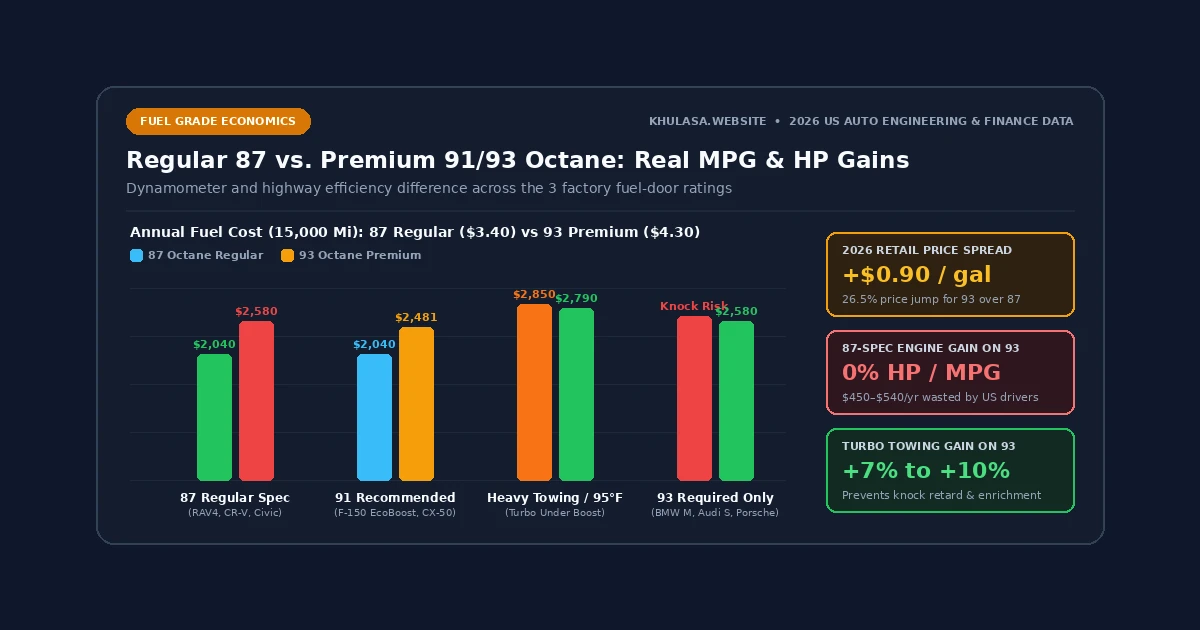
Ten years ago, the price gap between Regular 87-octane unleaded and Premium 91/93-octane gasoline sat around 20 to 25 cents per gallon. In 2026, that retail spread across U.S. stations averages $0.80 to $1.05 per gallon—meaning a 16-gallon fill-up of 93 octane costs $13 to $17 more every single time you visit the pump.
Despite that massive price spread, AAA engineering research found that 16.5 million U.S. drivers regularly buy premium gasoline for vehicles whose owner's manuals explicitly specify Regular 87 octane, wasting over $2.1 billion a year under the false belief that premium gas "burns cleaner" or "treats the engine." Conversely, millions of owners buying modern turbocharged trucks and crossovers see "87 Minimum / 91 Recommended" inside the fuel door and wonder whether the extra dollar per gallon ever pays for itself in better gas mileage.
Let's strip away the gas station marketing and examine what octane actually measures, what federal FTC consumer guidance and FuelEconomy.gov data show, and how to run the exact break-even math using our MPG & Trip Fuel Cost Calculator.
What Octane Actually Does (And What It Doesn't Do)
First, a critical physics fact: 93-octane premium gasoline does not contain more thermal energy per gallon than 87-octane regular gasoline. Both grades contain roughly 114,000 BTUs per gallon (for standard E10 fuel). Nor does premium gasoline automatically contain better fuel-injector detergents; federal EPA standards require detergents in all grades, and any station certified under the TOP TIER™ standard puts the exact same high-detergent additive package into its 87, 89, and 93 pumps.
An octane rating—displayed on yellow U.S. pump stickers as $(R+M)/2$, the average of Research Octane Number and Motor Octane Number—measures only one thing: how much heat and cylinder compression the fuel-air mixture can withstand before igniting spontaneously (knocking or pinging) prior to the spark plug firing.
- Naturally Aspirated Engines Designed for 87 Octane: If your engine's compression ratio and ignition timing map were engineered to reach peak cylinder pressure on 87 octane without knocking, pumping 93 octane into the tank does nothing. The engine control unit (ECU) will not advance spark timing beyond its factory 87-octane ceiling. You get 0% more horsepower, 0% better MPG, and 0% cleaner valves.
- High-Compression or High-Boost Turbo Engines ("Premium Recommended"): Modern turbocharged engines (like Ford's 2.7L/3.5L EcoBoost, Mazda's 2.5L Skyactiv-G Turbo, or BMW/Audi four-cylinders) use knock sensors to actively adjust ignition timing and turbo boost. On 91/93 octane, the ECU advances spark timing closer to Maximum Brake Torque (MBT). On 87 octane, the knock sensors detect incipient detonation and retard spark timing by 4 to 8 degrees—protecting the pistons from damage, but sacrificing thermal efficiency and peak power.
The 3 Fuel Door Labels Compared: Performance & Cost Math
To know how your car responds to octane, check the exact wording inside your fuel filler flap or owner's manual. Every gasoline vehicle falls into one of three engineering categories:
| Vehicle Category & Examples | Horsepower Gain on 93 vs. 87 Octane | Real-World MPG Gain on 93 vs. 87 | Extra Annual Fuel Cost for 93 Octane (15k Mi @ $0.90/Gal Spread) | Our Quantitative Verdict |
|---|---|---|---|---|
| 1. "87 Octane Regular Unleaded" (Toyota RAV4, Honda CR-V, Chevy Silverado 5.3L, Subaru Outback 2.5L) |
0.0% (No ECU timing advance beyond 87 map) | 0.0% to 0.3% (Statistically zero) | +$450 / yr wasted | Never buy Premium. Buy TOP TIER™ 87 Regular instead. |
| 2. "87 Minimum / 91–93 Recommended" (Ford F-150 EcoBoost, Mazda CX-50 Turbo, Honda Civic Si, Hyundai Santa Fe Turbo) |
+6% to +12% (+15 to +35 HP under heavy load) | +2.5% to +4.5% (Up to +7% when towing/summer heat) | +$310 to +$380 / yr net after MPG offset | Use 87 for flat commuting; switch to 91/93 for towing, mountain grades, or 95°F+ summer heat. |
| 3. "91/93 Premium Unleaded ONLY / Required" (Porsche, BMW M, Audi S/RS, Corvette, High-Output Luxury Turbos) |
Required for baseline spec; 87 triggers limp/knock protection | +5% to +8% vs emergency 87 use | Mandatory operating cost | Always use 91/93. Running 87 risks pre-ignition piston land damage under boost. |
Why the MPG Gain on "Premium Recommended" Cars Rarely Covers the Price Gap
Suppose you drive a turbocharged SUV rated at 25 MPG that "recommends" 91/93 octane but safely allows 87. At 2026 national averages ($3.40/gal for 87 Regular vs. $4.30/gal for 93 Premium), premium fuel costs 26.5% more per gallon.
For 93 octane to save you money purely through better fuel economy, your vehicle's MPG would have to improve by 26.5% (jumping from 25.0 MPG to 31.6 MPG). In independent dynamometer and highway testing by AAA and FuelEconomy.gov, "Premium Recommended" turbo engines gain an average of 2.7% to 4.5% in fuel economy on 93 octane during normal driving. That boosts a 25.0 MPG crossover to roughly 26.0 MPG:
- Annual cost on 87 Regular (25.0 MPG, 15,000 miles @ $3.40/gal): 600 gallons = $2,040 / year ($0.136 per mile).
- Annual cost on 93 Premium (26.0 MPG, 15,000 miles @ $4.30/gal): 577 gallons = $2,481 / year ($0.165 per mile).
Even after accounting for the 23 gallons of fuel saved through higher thermal efficiency, pumping 93 octane still costs you $441 more per year. You can verify how fuel grade spreads change your total operating budget in our Cost Per Mile Calculator.
When Pumping 91/93 Octane in a "Recommended" Turbo Engine IS Worth Every Penny
If 93 octane doesn't pay for itself during a flat 65-mph commute to the office, when should you actually pay the extra dollar per gallon in a "Premium Recommended" vehicle? Three specific operating conditions change the thermodynamics inside your cylinders:
- Towing a Trailer or Hauling a Full Family up Mountain Grades: When a turbocharged engine operates under sustained high boost at low-to-mid RPM (climbing a 6% grade on I-70 or pulling a 5,000-pound camper), intake air temperatures soar and cylinder pressures stay maxed out. On 87 octane, the ECU must heavily retard ignition timing AND dump extra unburned fuel into the cylinders ("cat overtemp enrichment") just to cool the exhaust valves and catalytic converters. Under heavy towing loads, 91/93 octane can improve fuel economy by 7% to 10% while keeping cylinder head temperatures significantly safer.
- 95°F+ Summer Heat With Air Conditioning Running: Hot ambient air combined with a heat-soaked intercooler dramatically increases knock sensitivity in stop-and-go summer traffic. If your turbo crossover feels sluggish or hesitates when pulling away from stoplights in July and August, switching to 91/93 octane restores the factory low-end torque curve.
- Track Days or Enthusiast Driving: For instance, Mazda's 2.5L Turbo engine is explicitly rated at 227 horsepower on 87 octane and 250 horsepower (plus 10 lb-ft of torque) on 93 octane. If you bought the turbo upgrade for passing power, you only get the top 23 horsepower above 4,000 RPM when the tank has 91/93 octane.
For more ways to cut your real-world fuel bill without sacrificing engine health, read our deep dive on how roof racks and low tire pressure quietly destroy highway MPG and compare long-term powertrain costs in our Hybrid vs. Gas 5-Year Payback Study.