
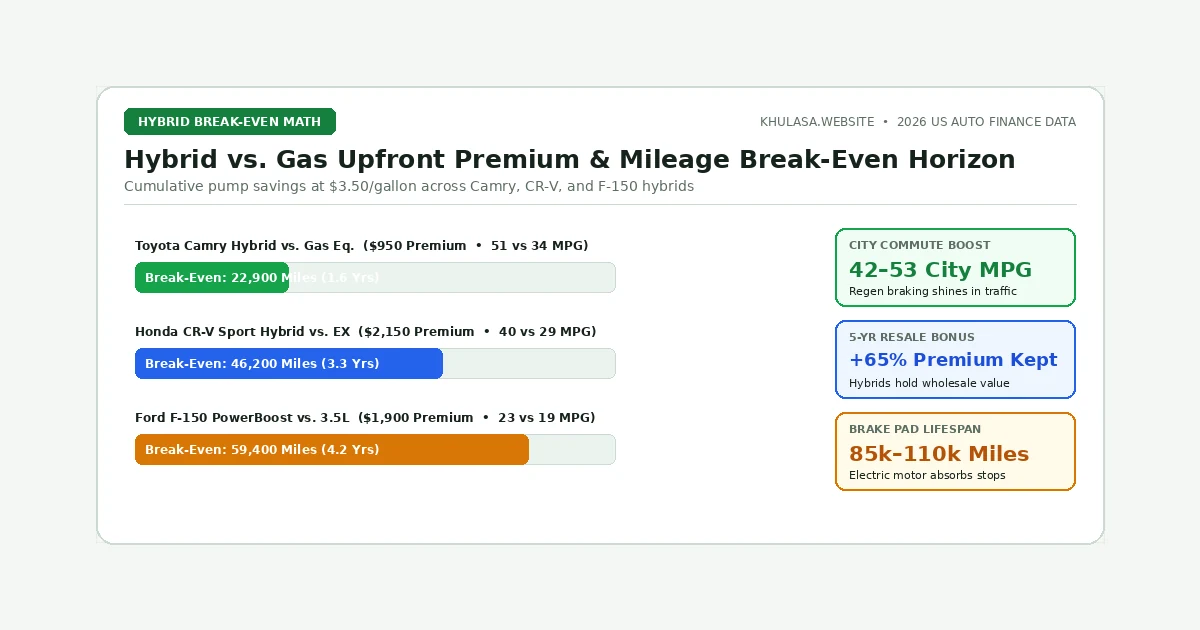
A decade ago, choosing a hybrid meant paying a $4,500 sticker surcharge for a slow compact hatchback that took seven years and 105,000 miles of driving just to break even at the gas pump. That old stereotype no longer holds up in 2026. Today, Toyota sells the Camry and RAV4 exclusively as hybrids, Honda's 204-horsepower two-motor hybrid system in the Civic and CR-V accelerates faster and smoother than its 1.5-liter turbo gas sibling, and the upfront price gap between comparable gas and hybrid trims has shrunk to $1,500 to $2,150.
Does every driver automatically save money in a hybrid? Not necessarily. When Elena and I compare side-by-side city and highway window stickers on FuelEconomy.gov and battery warranty rules documented by the Department of Energy Alternative Fuels Data Center, three variables decide whether your payback takes 26 months or 7 years: your annual mileage, your city-versus-interstate driving split, and five-year wholesale residual retention.
The Exact Break-Even Mileage Formula
Before factoring in resale value, you can calculate the exact odometer mileage required for fuel savings alone to pay back a hybrid's upfront price premium (including sales tax on that premium) using this equation:
Fuel Savings per Mile = (Gas Price ÷ Gas MPG) − (Gas Price ÷ Hybrid MPG)
Break-Even Miles = Upfront Hybrid Price Premium ($) ÷ Fuel Savings per Mile ($)
Let's test this on a 2026 Honda CR-V EX AWD (29 MPG Combined) vs. a 2026 Honda CR-V Sport Hybrid AWD (37 MPG Combined / 40 MPG City) with an upfront out-the-door price premium of $2,150 and gasoline at $3.50/gallon:
- Gas CR-V fuel cost per mile (29 MPG):
$3.50 ÷ 29 = $0.1207 per mile - Hybrid CR-V fuel cost per mile (37 MPG combined):
$3.50 ÷ 37 = $0.0946 per mile - Net fuel savings per mile:
$0.1207 − $0.0946 = $0.0261 per mile($261.00 saved every 10,000 miles) - Break-even odometer mileage (combined driving):
$2,150 ÷ $0.0261/mile = 82,375 miles(or 5.49 years at 15,000 miles/year). - What if you drive 80% in stop-and-go city traffic (27 MPG Gas vs. 40 MPG Hybrid)? Your per-mile savings jumps to
$0.1296 − $0.0875 = $0.0421/mile, slashing your break-even mileage to 51,069 miles (just 3.4 years at 15,000 miles/year)!
2026 Head-to-Head Hybrid vs. Gas Payback Table Across 5 Popular Models
Use our Fuel Savings Calculator or consult the model-by-model comparison table below (calculated at 15,000 miles/year and $3.50/gallon regular unleaded) to see how five head-to-head gas vs. hybrid matchups perform:
| Model Comparison (Comparable Equipment Trims) | Upfront Hybrid Price Premium | Gas Combined MPG | Hybrid Combined MPG | Annual Fuel Savings (@ 15k Mi) | Fuel-Only Break-Even Miles (Years) | 5-Year Net Gain Incl. Resale Retention |
|---|---|---|---|---|---|---|
| Honda Civic: Sport Gas vs. Sport Hybrid | +$1,950 | 34 MPG | 48 MPG | $450.37 / yr | 64,947 mi (4.3 yrs) | +$1,502 ahead |
| Hyundai Tucson: SEL AWD Gas vs. Blue Hybrid AWD | +$1,750 | 26 MPG | 38 MPG | $637.65 / yr | 41,167 mi (2.7 yrs) | +$2,488 ahead |
| Kia Sportage: EX Gas vs. EX Hybrid AWD | +$1,500 | 28 MPG | 38 MPG | $493.42 / yr | 45,599 mi (3.0 yrs) | +$1,967 ahead |
| Honda CR-V: EX AWD Gas vs. Sport Hybrid AWD | +$2,150 | 29 MPG | 37 MPG | $391.43 / yr | 82,390 mi (5.5 yrs) | +$1,157 ahead |
| Ford F-150 XLT 4x4: 3.5L EcoBoost vs. 3.5L PowerBoost Hybrid | +$1,900 | 19 MPG | 23 MPG | $480.55 / yr | 59,307 mi (4.0 yrs) | +$1,653 ahead |
Why Pure Highway Commuters Save Less in a Hybrid Than Urban Commuters
Look closely at how a series-parallel hybrid powertrain (Toyota Hybrid Synergy Drive, Ford PowerBoost, or Hyundai/Kia 6-speed hybrid) actually saves fuel: it captures kinetic energy during braking via a regenerative electric motor-generator, stores that energy in a compact 1.1 to 1.6 kWh lithium-ion buffer battery, and uses the electric motor to launch the vehicle from stoplights and propel it at low speeds while the gasoline engine is shut off completely.
City traffic is where hybrids shine. In stop-and-go commuting, a hybrid's gas engine stays off 35% to 50% of the time, allowing a 3,700-pound SUV to achieve 40+ MPG in the city. On an open rural interstate at a steady 75 mph, however, you rarely touch the brake pedal, so there is almost no regenerative braking energy to harvest, and the gasoline engine must run continuously to overcome aerodynamic drag. At 75 mph, a hybrid crossover's advantage over a modern 8-speed or CVT non-hybrid crossover shrinks from 13 MPG in the city to just 4 to 6 MPG on the open highway.
The Hidden Bonus That Cuts Hybrid Payback Time in Half: Resale Value & Brake Longevity
Evaluating a hybrid strictly on fuel receipts ignores two major financial advantages that show up in our Total Cost of Car Ownership Calculator:
- Higher 5-Year Residual Value: In wholesale auction data tracked by Black Book and iSeeCars, hybrid trims of the CR-V, Tucson, Sportage, and Corolla retain 55% to 62% of their upfront hybrid price premium at 5-year trade-in. If you pay $1,950 extra for a hybrid today and it sells for $1,150 more than the gas trim five years from now, your true net depreciation premium was only $800, which fuel savings pay back in less than 18 months!
- 80,000-Mile Brake Pad Life & Simplified Accessory Belts: Because regenerative braking handles 70%+ of normal deceleration on a hybrid, factory brake pads and rotors routinely last 85,000 to 110,000 miles, saving a $650 to $850 mid-life brake job that a standard gas crossover requires around 45,000 miles. Plus, Toyota and Honda e-CVT hybrids eliminate conventional starter motors, alternators, and serpentine belts entirely.
What about Plug-In Hybrids (PHEVs) like the Toyota RAV4 Prime or Tucson Plug-In Hybrid? Because PHEVs carry a much larger 14 to 18 kWh battery pack and a $5,500 to $8,500 price premium over standard hybrids, they only break even financially if you can lease them with a factory cap-cost rebate or plug them in at home every single night on low-cost electricity. Compare both options in our EV vs Gas Cost Calculator.