
Drive through any suburban grocery store parking lot in mid-October and count how many crossovers are still wearing their rooftop ski boxes or kayak cradles from July. Most owners treat roof racks like permanent trim pieces. Bolting on a pair of aluminum crossbars takes twenty minutes with an Allen key, so once they are up there, nobody bothers taking them off between road trips.
That convenience carries a quiet, compounding tax every time you merge onto the interstate. Unlike extra weight inside the cabin—which mostly hurts stop-and-go city driving—anything mounted to the outside of your car attacks aerodynamic drag. Because aerodynamic drag increases with the square of your velocity, and the horsepower required to push through that air increases with the cube of velocity, a plastic cargo pod that barely registers at 30 mph turns into a parachute at 75 mph.
To quantify what external gear and neglected tire maintenance actually cost on U.S. highways, we combined wind-tunnel test results from the U.S. Department of Energy's Oak Ridge National Laboratory with federal rolling-resistance benchmarks from FuelEconomy.gov. You can plug your own daily commute and local gas prices directly into our MPG & Trip Fuel Cost Calculator to see how these penalties hit your specific vehicle.
Why Speed Multiplies the Roof Rack Penalty
Every vehicle leaves the factory with a specific drag coefficient ($C_d$) and frontal area ($A$). A modern compact sedan like a Honda Civic or Toyota Prius slices through the air with a $C_d$ around 0.26 to 0.28. A midsize crossover like a Toyota RAV4 or Subaru Outback sits closer to 0.32 to 0.35. Engineers spend millions of hours in wind tunnels shaving thousandths of a point off those numbers by sculpting side mirrors, adding active grille shutters, and flattening underbody panels.
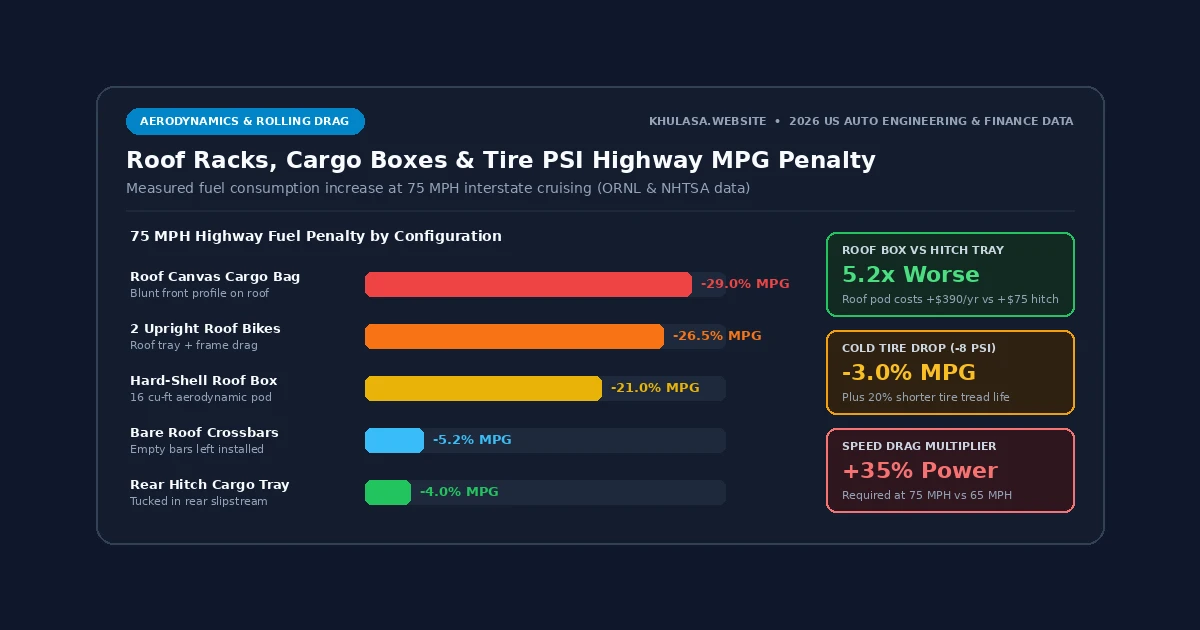
When you clamp a pair of bare aftermarket crossbars onto the roof rails, you interrupt the smooth laminar airflow accelerating over the top of the windshield. Even without a single piece of luggage attached, bare crossbars create turbulent wake vortices that increase total aerodynamic drag by 3% to 5%. Clamp a 16-cubic-foot hard-shell cargo box onto those bars, and you increase both the vehicle's frontal area and its drag coefficient simultaneously.
| Configuration / Accessory | City MPG Penalty (30–45 MPH) | Interstate MPG Penalty (65 MPH) | High-Speed MPG Penalty (75 MPH) | Annual Fuel Cost Penalty (15,000 Miles @ $3.60/Gal, 30 MPG Base) |
|---|---|---|---|---|
| Bare Roof Crossbars Only (Empty) | 0.5% – 1.5% | 2.5% – 4.0% | 4.5% – 6.0% | +$68 to +$115 / yr |
| Aerodynamic Hard-Shell Roof Cargo Box | 2.0% – 5.0% | 12.0% – 17.0% | 19.0% – 25.0% | +$295 to +$480 / yr |
| Roof-Mounted Canvas Cargo Bag (Blunt Front) | 4.0% – 7.0% | 18.0% – 24.0% | 26.0% – 32.0% | +$430 to +$635 / yr |
| Two Upright Roof Bicycle Mounts (With Bikes) | 3.0% – 6.0% | 15.0% – 21.0% | 24.0% – 29.0% | +$360 to +$560 / yr |
| Rear Hitch-Mounted Cargo Tray / Platform | 0.5% – 1.0% | 1.5% – 4.5% | 3.0% – 6.0% | +$45 to +$110 / yr |
Look closely at the difference between a roof-mounted cargo box and a rear hitch-mounted cargo tray. Because a hitch tray sits inside the low-pressure aerodynamic slipstream directly behind the tailgate, it barely disturbs the air flowing over the vehicle. Oak Ridge National Laboratory testing showed that moving the exact same cargo load from the roof to a rear hitch tray cuts the highway fuel penalty by roughly 75% to 80%.
Why Sedans Suffer Worse Percentage Losses Than Boxy SUVs
One of the most counterintuitive findings in wind-tunnel testing is that sleek sedans and electric hatchbacks lose a much higher percentage of their fuel economy (or battery range) from a roof box than a boxy truck or three-row SUV. In ORNL's controlled tests comparing a Nissan Altima sedan (base $C_d$ 0.31) against a Toyota RAV4 crossover (base $C_d$ 0.35), mounting an identical rooftop cargo pod increased total aerodynamic drag on the sedan by nearly 39%, resulting in a 19% to 25% fuel consumption jump at 65–75 mph. On the taller, boxier RAV4, the same cargo pod increased fuel consumption by roughly 13% to 15%.
Why? Because a sleek sedan achieves its 38 MPG highway rating specifically through ultra-low aerodynamic drag. Disrupting that clean airflow ruins its primary efficiency advantage. If you drive an electric sedan or crossover—where highway efficiency already drops in winter—bolting a ski box to the roof can easily knock 45 to 65 miles off your real-world highway range between fast-charging stops. You can compare how efficiency changes affect electric versus combustion drivetrains in our EV vs. Gas Total Cost Calculator.
The Cold-Morning Tire Pressure Trap
While roof racks punish you above 55 mph, underinflated tires drain your tank at every speed—and they do their worst damage in autumn and winter. According to National Highway Traffic Safety Administration (NHTSA) tire safety data, passenger tires naturally lose about 1 PSI per month through normal rubber permeation. More importantly, the Ideal Gas Law ($PV = nRT$) dictates that sealed tire air pressure drops by roughly 1 PSI for every 10°F drop in ambient temperature.
Here is how that plays out in real life: Suppose you set your tires to the door-jamb specification of 35 PSI on an 80°F afternoon in late August. By mid-November, when morning temperatures hit 30°F, your tires have lost 5 PSI from temperature contraction alone, plus another 2.5 to 3 PSI from three months of natural permeation. You are now rolling down the highway at 27 PSI—nearly 23% below factory spec—often right on the threshold before your dashboard TPMS warning light bothers to illuminate (federal FMVSS 138 rules only require TPMS lights to trigger when pressure falls 25% below the placard rating).
| Tire Inflation Status (vs. Door Jamb Spec) | Rolling Resistance Increase | Fuel Economy Penalty | Tire Tread Life Reduction | Added Annual Cost (Fuel + Premature Tire Wear) |
|---|---|---|---|---|
| 35 PSI (Factory Door Placard Spec) | Baseline (0%) | 0.0% | 0% (Full 50,000-mi life) | $0 (Baseline) |
| 30 PSI (5 PSI Underinflated — No Warning Light) | +6.0% to +8.0% | -1.0% to -1.5% | -10% (~45,000-mi life) | +$105 to +$145 / yr |
| 27 PSI (8 PSI Underinflated — Autumn Cold Drop) | +12.0% to +15.0% | -2.4% to -3.2% | -20% (~40,000-mi life) | +$215 to +$290 / yr |
| 23 PSI (12 PSI Underinflated — Neglect / Slow Leak) | +22.0% to +28.0% | -4.0% to -5.5% | -35% (~32,500-mi life) | +$390 to +$510 / yr |
When a tire runs 8 PSI low, its sidewalls flex excessively with every revolution. That mechanical flexing converts kinetic energy directly into heat inside the rubber compound—which is why severely underinflated tires both waste fuel and suffer catastrophic shoulder wear or highway blowouts. Even if you only lose 2.5% in fuel economy from soft tires, the hidden hit to your True Cost Per Mile comes from replacing an $850 set of tires 10,000 miles early.
Dead Weight vs. Aerodynamic Drag: What Actually Matters?
Drivers frequently obsess over cleaning heavy items out of their trunk while leaving empty bike racks clamped to the roof. According to FuelEconomy.gov testing, carrying an extra 100 pounds of dead weight inside the trunk reduces fuel economy by only about 1% (slightly more in lightweight subcompact cars, slightly less in full-size pickup trucks). Why? Because once mass is accelerated up to cruising speed on a flat interstate, it stays in motion; weight mainly costs energy during acceleration and hill climbing.
Aerodynamic drag never stops fighting your engine. Carrying 75 pounds of camping gear inside the trunk costs you roughly 0.7% in fuel economy. Strapping that exact same 75 pounds of camping gear inside a bluff-fronted canvas bag on your roof rack costs you 20% to 28% at 70 mph—nearly thirty times worse.
4 Practical Rules to Reclaim Your Highway Efficiency
- Treat roof racks like seasonal footwear, not permanent fixtures: If you aren't hauling skis, kayaks, or extra luggage this weekend, unbolt the cargo box and crossbars. Storing a roof box in the garage for the 48 weeks a year you don't need it saves the average highway commuter $250 to $400 annually.
- Buy a hitch receiver instead of roof bars for family road trips: A 2-inch trailer hitch receiver paired with a folding rear cargo platform keeps bulky coolers and suitcases tucked inside the vehicle's rear wake, cutting aerodynamic drag losses by four-fifths while sparing you from lifting 50-pound bags overhead.
- Check tire pressure cold on the first Saturday of every month: Always measure pressure before driving (or at least three hours after parking) using the PSI printed on the driver's door jamb sticker—never the "Max Press" molded into the tire sidewall. Add 1 PSI for every 10°F that seasonal temperatures drop.
- Drop your cruising speed by 5 mph when hauling rooftop gear: If you must travel with a rooftop cargo box or upright bikes, setting your cruise control at 65 mph instead of 75 mph cuts aerodynamic power demand by roughly 35%, extending both your tank range and your sanity from wind noise. For more ways to trim recurring vehicle overhead, review our breakdown of proven ways to reduce annual car ownership costs and compare long-term vehicle upkeep in our 5-year car depreciation and operating cost study.