
The single biggest financial fear keeping used-car shoppers away from three-year-old electric vehicles is the prospect of a $14,000 high-voltage battery replacement right after the warranty expires. That anxiety was born in the early 2010s, when first-generation Nissan Leafs lacked active liquid thermal management and routinely lost 30% of their range within five summers in Phoenix or Miami.
In 2026, liquid-cooled EV battery packs behave nothing like those early air-cooled experiments. Drawing on multi-year testing from the U.S. Department of Energy's Idaho National Laboratory (INL), battery lifespan modeling from the National Renewable Energy Laboratory (NREL), and real-world fleet telemetry spanning more than 15,000 modern electric vehicles, we can track exactly how lithium-ion packs age from 0 to 150,000 miles—and how to protect your EV's resale value. You can compare total ownership economics in our EV vs. Gas Total Cost Calculator.
The S-Curve of EV Battery Aging: Why You Lose 5% in Year One and Almost Nothing After
New EV owners frequently panic when their car loses 4% to 5% of its rated range during the first 15,000 miles. If you extrapolate a 5% annual loss linearly, you would assume the battery will lose 40% of its capacity by Year 8. Fortunately, lithium-ion chemistry does not degrade in a straight line; it follows a distinct three-stage S-curve:
- Phase 1 — Initial SEI Layer Formation (0 to 20,000 Miles): During the first year of cycling, lithium ions react with the electrolyte on the graphite anode to form a protective Solid Electrolyte Interphase (SEI) film. This initial chemical passivating layer permanently consumes 3.5% to 5.5% of the pack's mobile lithium inventory.
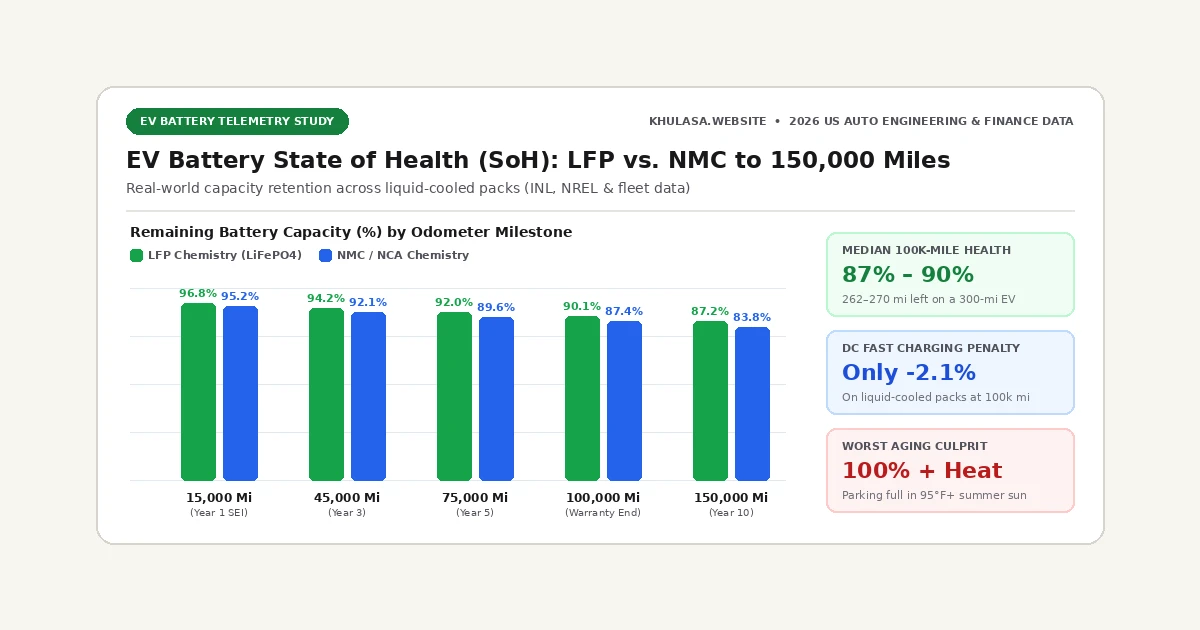
- Phase 2 — The Long Linear Plateau (20,000 to 150,000+ Miles): Once the SEI layer stabilizes, degradation slows dramatically to roughly 1.0% to 1.5% per 25,000 miles. Across modern liquid-cooled packs, the median State of Health (SoH) at 100,000 miles sits between 87% and 91% of original capacity.
- Phase 3 — End-of-Life Knee (Typically 200,000+ Miles): Only after thousands of deep charge cycles does lithium plating or cathode micro-cracking accelerate capacity drop—far beyond the mileage where most combustion engines or transmissions require major overhauls.
| Odometer Milestone | LFP Chemistry State of Health (LiFePO4) | NMC / NCA Chemistry State of Health (Nickel-Rich) | Real-World Range Retained (on a 300-Mile Rated EV) | Federal / California Warranty Threshold |
|---|---|---|---|---|
| New Delivery (0 Miles) | 100.0% | 100.0% | 300 Miles | 70% SoH for 8 Yrs / 100k Mi |
| Year 1 / 15,000 Miles | 96.8% | 95.2% | 286 – 290 Miles | Covered |
| Year 3 / 45,000 Miles | 94.2% | 92.1% | 276 – 283 Miles | Covered |
| Year 5 / 75,000 Miles | 92.0% | 89.6% | 269 – 276 Miles | Covered |
| Year 7 / 100,000 Miles | 90.1% | 87.4% | 262 – 270 Miles | Warranty Expiration Point |
| Year 10 / 150,000 Miles | 87.2% | 83.8% | 251 – 262 Miles | Post-Warranty (Normal Operation) |
LFP vs. NMC Battery Chemistry: Why the Rules Changed
Not all EV batteries use the same cathode recipe, and knowing which chemistry sits underneath your floorboards completely changes how you should charge the vehicle. As detailed by the DOE Alternative Fuels Data Center, today's EV market is split between two primary lithium-ion chemistries:
1. Nickel Manganese Cobalt (NMC) & Nickel Cobalt Aluminum (NCA)
Used in long-range and performance models (such as Long Range Tesla Model 3/Y, Hyundai Ioniq 5/6, Kia EV6/EV9, Ford Mustang Mach-E Extended Range, Chevrolet Equinox EV, and Rivian Dual/Max packs), nickel-rich cells pack roughly 25% more energy per kilogram. They excel in freezing weather and deliver higher peak power. However, NMC cathodes experience high structural stress and electrolyte oxidation when held above 4.15 volts per cell (roughly 85% to 100% State of Charge), especially in warm temperatures. For NMC packs, capping your daily home charge limit at 80% can reduce calendar aging by up to 40%.
2. Lithium Iron Phosphate (LFP / LiFePO4)
Used in standard-range models (such as Base RWD Tesla Model 3, Ford Mustang Mach-E Standard Range, and Rivian Standard packs), LFP cells contain zero cobalt or nickel. Their olivine crystal structure is vastly more stable thermally and chemically, capable of enduring 3,000 to 4,000 full charge cycles before dropping to 80% capacity (compared to 1,200–1,800 cycles for NMC). Even better, LFP batteries have an extremely flat voltage curve between 15% and 95% charge—meaning the car's Battery Management System (BMS) actually needs you to charge to 100% once a week just to calibrate its range gauge accurately. That said, still avoid leaving an LFP pack parked at 100% in 100°F summer sun for days on end.
Does Frequent DC Fast Charging Actually Ruin EV Batteries?
For years, owners were warned that plugging into a 150 kW or 350 kW Level 3 DC fast charger (Supercharger, Electrify America, EVgo) would rapidly cook their battery pack. While early lab tests by Idaho National Laboratory on 2012-era Nissan Leafs showed noticeable degradation from twice-daily fast charging in desert heat, modern telemetry on liquid-cooled 2020–2026 EVs tells a far more reassuring story.
Across vehicles equipped with active liquid cooling and preconditioning pumps, cars that rely on DC fast charging for over 70% of their charging sessions show only 1.5% to 2.8% more degradation at 100,000 miles than cars charged exclusively on a 240V Level 2 home charger.
Why is the difference so small? Because modern BMS computers aggressively manage cell temperature (heating or chilling the glycol coolant loop to 75°F–95°F before fast charging) and taper the charging amperage sharply once the pack crosses 60% to 80% State of Charge to prevent lithium plating on the anode.
What Actually Accelerates Battery Degradation: Calendar Heat + High SoC
According to NREL battery lifespan studies, the single biggest enemy of an EV battery isn't fast charging on road trips—it is Calendar Aging caused by parking a vehicle at a high State of Charge (90%–100%) in hot climates. An EV parked outdoors in Arizona or Texas at 100% charge degrades nearly twice as fast as the exact same EV parked at 50%–70% charge in Seattle or Chicago.
4 Habits That Keep Your EV Battery Above 90% Health at 100k Miles
- Follow the 20%–80% Daily Rule for NMC Batteries: Set your home charger limit to 70% or 80% for everyday commuting. Only slide the limit to 100% the morning of a long highway trip so the car doesn't sit overnight at peak cell voltage.
- Never Leave an EV Parked at 100% or Below 5% in Summer Heat: If you are leaving your car at an airport parking lot for two weeks in July, leave the battery between 40% and 55% State of Charge. That resting voltage minimizes parasitic SEI growth.
- Use Built-In Navigation to Precondition Before DC Fast Charging: Entering the fast charger into your car's native GPS allows the thermal pump to warm or cool the battery before you plug in, reducing internal cell resistance and cutting charging time by 15 minutes.
- Ask for a BMS State-of-Health (SoH) Readout Before Buying a Used EV: Just as you would order a compression check on a used gas car, use an OBD-II dongle or dealer diagnostic scan to verify the battery's usable kWh capacity before buying a used EV. You can model how battery longevity and used EV rebates affect your numbers in our Car Depreciation Calculator, and read our companion study on winter EV range loss: heat pumps vs. resistive heaters.