
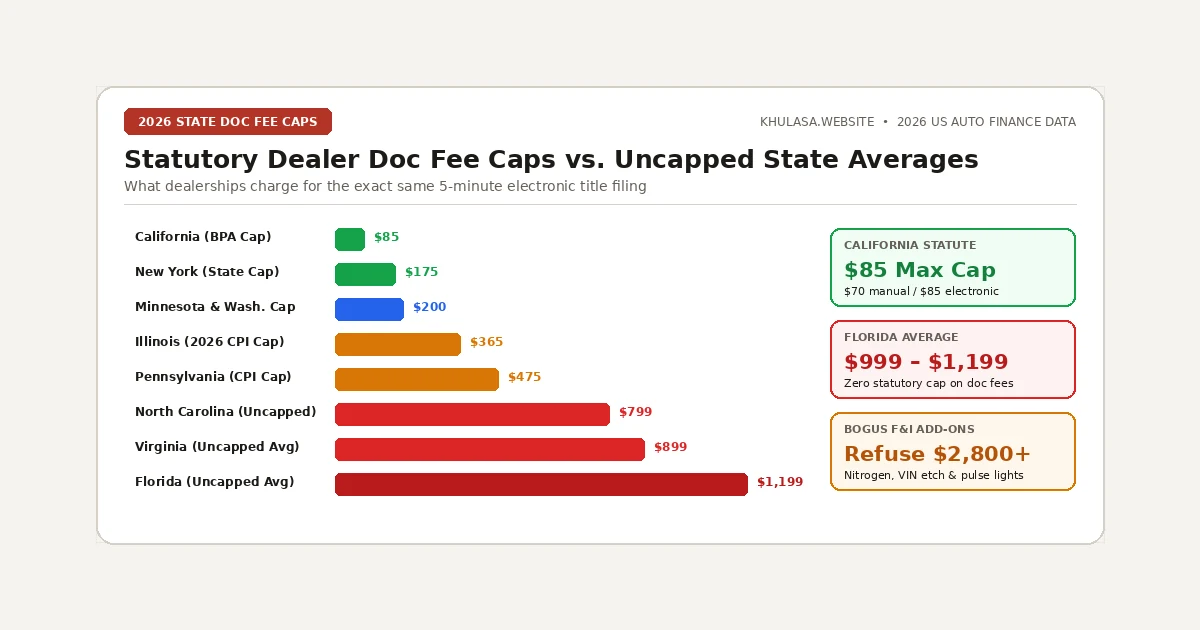
Last month, while auditing three buyer's orders sent in by readers in California, New York, and Florida, I noticed the exact same five-minute electronic DMV title filing billed at three wildly different prices. On a Los Angeles contract, the documentary preparation charge sat at $85.00. On an Albany worksheet, it was $175.00. Then I opened a buyer's order for a 2026 Mazda CX-50 from an Orlando dealership. Sandwiched between the negotiated $32,400 selling price and the state sales tax line were four pre-printed charges totaling $2,888.00: a $999.00 Documentary Service Fee, $399.00 for "Electronic Tag Filing," $695.00 for a pulsing third brake light relay, and $795.00 for nitrogen tire air and paint sealant.
I see this mistake every week. Buyers spend three hours grinding out a $1,500 discount off the window sticker, only to hand back $2,800 inside the Finance & Insurance (F&I) office ten minutes later. Why? Because dealership contract templates mix mandatory government taxes with 95%-margin dealer profit items in the exact same column. According to the Federal Trade Commission (FTC) Buying a New Car Guide, dealers must clearly separate optional add-ons from official government fees.
The Three Legal Buckets on Every Auto Buyer's Order
Every single dollar added below a vehicle's negotiated selling price falls into one of three distinct legal categories:
- Mandatory Government Taxes & DMV Title/Registration Fees (Non-Negotiable): State and county motor vehicle sales or use tax, certificate-of-title fees, license plate and weight registration fees, and small statutory tire-recycling or inspection fees ($2 to $15). By statute, the dealership collects these dollar-for-dollar on behalf of your state DMV and Department of Revenue.
- Dealer Documentation ("Doc") Fee (State-Capped or Uncapped Dealer Revenue): A private administrative charge set by the dealership for processing contracts, verifying odometer disclosures, and transmitting electronic title paperwork.
- Dealer-Installed Accessories & F&I Protection Packs (100% Optional & Negotiable): Nitrogen-filled tires, window tint, VIN glass etching, paint/fabric sealant, LoJack/GPS trackers, and used-car "reconditioning" fees.
2026 State-by-State Dealer Documentation Fee Laws: Statutory Caps vs. Uncapped Averages
Only a minority of US states enforce a statutory ceiling on dealership documentation fees. Even among capped states, the rules vary between flat statutory limits (like New York and California's baseline electronic filing rules under the California DMV Vehicle Industry Registration Procedures Manual) and annual Consumer Price Index (CPI) inflation adjustments in states like Illinois and Pennsylvania. Here is how the major state doc fee regimes compare in 2026:
| State | Statutory Cap Status (2026) | 2026 Legal Maximum / Typical Dealer Charge | Is the Doc Fee Subject to Sales Tax? |
|---|---|---|---|
| California | Strictly Capped by Statute (CA Veh. Code) | $85 baseline cap via DMV Electronic BPA program ($70 manual; subject to CA statutory reform limits) | Yes (Taxed as part of gross retail sale) |
| New York | Strictly Capped by DMV Regulation (15 NYCRR § 78.19) | $175 maximum statewide (no extra e-filing markups allowed) | Yes |
| Minnesota | Strictly Capped by Statute (Minn. Stat. § 168.27 Subd. 31) | $200 statutory maximum ($125–$200 tiered statutory limit) | No (Exempt when separately itemized) |
| Washington | Strictly Capped by Statute (RCW 46.70.180) | $200 maximum negotiable documentary service fee | Yes |
| Texas | Regulatory Cost-Justification Threshold (OCCC) | $150 – $225 standard ($225 safe-harbor; higher requires OCCC cost audit) | No (Exempt from 6.25% motor vehicle tax) |
| Illinois | Annual CPI Inflation-Indexed Cap (815 ILCS 375/11.1) | ~$365 – $368 statutory maximum (adjusted each January by CPI) | Yes |
| Ohio | Strictly Capped by Statute (ORC § 1317.07) | $387 statutory cap (or 10% of vehicle price, whichever is less) | Yes |
| Pennsylvania | Annual CPI Inflation-Indexed Cap (PA MVSFA) | ~$464 – $490 max for online PennDOT Messenger electronic filing (~$390–$410 manual) | No |
| North Carolina & Georgia | Uncapped (Mandatory Disclosure Only) | $699 – $899 typical franchise dealer charge | Yes |
| Virginia | Uncapped ("Processing Fee" Disclosure) | $799 – $995 typical franchise dealer charge | Yes (Included in 4.15% gross sales tax base) |
| Florida | Uncapped (Highest in the United States) | $899 – $1,199 typical (+ $199–$399 "Electronic Filing / Private Tag Fee") | Yes (Subject to 6% state sales tax) |
Understanding California's $85 BPA Rule and Inflation-Indexed Caps in Illinois and Pennsylvania
Three states deserve a closer look because dealers frequently misquote their own statutory rules at the closing desk:
- California ($85 Electronic BPA Baseline vs. Legislative Updates): Under California Vehicle Code § 4456.5 and § 11713.1, California long enforced the strictest documentary preparation cap in the nation: $85 maximum when the dealership participates in the DMV's electronic Business Partner Automation (BPA) program (and $70 for manual non-BPA dealers), plus the exact pass-through cost of the electronic filing fee (~$33) and smog certification fee. Even when legislative proposals (such as AB 1755 / statutory cap adjustments) are debated in Sacramento, California strictly forbids dealers from inventing secondary $495 "admin" or "prep" fees on top of the statutory doc fee cap.
- Illinois and Pennsylvania (Annual CPI Indexing): Unlike New York's fixed $175 ceiling, both Illinois (under 815 ILCS 375/11.1) and Pennsylvania (under the Motor Vehicle Sales Finance Act administered by the PA Department of Banking and Securities) tie their statutory doc fee ceilings to the federal Consumer Price Index (CPI-U). Every January, state regulators publish the updated ceiling: roughly $365 to $368 in Illinois and $464 to $490 for online PennDOT Messenger electronic registration dealers in Pennsylvania. Dealers like to point to the state regulator's notice and claim the state "charges" that amount. Read the statute carefully. Those figures are legal maximums, not mandatory minimum taxes.
How to Beat a $999 Uncapped Doc Fee When the Dealer Says "We Charge Everyone This"
Challenge an $899 or $1,199 doc fee in Miami, Atlanta, or Charlotte, and the sales manager will tap the pre-printed line on the Buyer's Order and deliver a rehearsed speech: "Under federal fair-lending compliance rules, we are legally required to charge the exact same doc fee to every customer who buys a car here."
That statement is half true. It is also completely irrelevant to your wallet. While dealerships keep the printed doc fee line fixed at $999 so no borrower can allege disparate pricing, nothing in any state or federal statute prevents the dealer from reducing the selling price of the vehicle by $800 to offset a bloated $999 doc fee.
To win that negotiation, refuse to haggle over individual fee lines. Instead, negotiate strictly on the Out-the-Door (OTD) Price using our Car Registration & Tax Calculator before you ever step into the showroom. When you email three competing dealerships and request their lowest written Out-the-Door total (including all doc fees, electronic filing charges, and taxes), a Florida dealer charging a $1,199 doc fee must discount the vehicle $800 deeper than a competitor charging $399 just to win your cashier's check.
Five High-Margin Dealership Add-Ons You Should Refuse on Sight
According to consumer enforcement guidance from the FTC Consumer Advice portal, you are never obligated to pay for pre-installed accessories or F&I protection packages that were not disclosed in the advertised price. Cross these five profit packs off your worksheet immediately:
- Nitrogen Tire Fill ($199 to $399): Ambient atmospheric air at your neighborhood gas station compressor is already 78% nitrogen. Paying $299 for 95% nitrogen in passenger tires delivers zero measurable fuel-economy or tread-life benefit on street vehicles.
- VIN Window Etching & "Theft Recovery" Decals ($299 to $695): Your vehicle's 17-digit VIN is already stamped into the metal dashboard, door jamb, firewall, and engine block at the factory. A $22 acid-stencil kit applied to window glass does not stop professional thieves.
- "Pulse" Third Brake Light Flasher ($399 to $599): This is a $14 plug-and-play relay wired into the center stop lamp that blinks three times when you tap the brakes. Tell the sales manager to unplug the relay or reduce the vehicle price by the exact charge.
- Paint & Fabric "Environmental Protection" Packages ($695 to $1,495): Marketed as "ceramic coating" or "interior fabric warranty," this is usually a $35 spray-on polymer sealant applied in twenty minutes in the wash bay. What you are really buying is a restrictive appearance contract packed with exclusions.
- Used-Car "Reconditioning & Safety Inspection Fee" ($895 to $1,995): Some used-car lots advertise a vehicle $1,500 below market value online to rank first on listing sites, then ambush you in the finance office with a mandatory $1,695 "Shop Reconditioning Fee." Walk out on the spot.
Before signing any retail installment contract, verify your final numbers in our Monthly Car Payment Calculator to confirm that zero unauthorized add-ons were slipped into the "Amount Financed" box, and read our breakdown on why you should also decline the F&I office's $995 GAP insurance markup.