
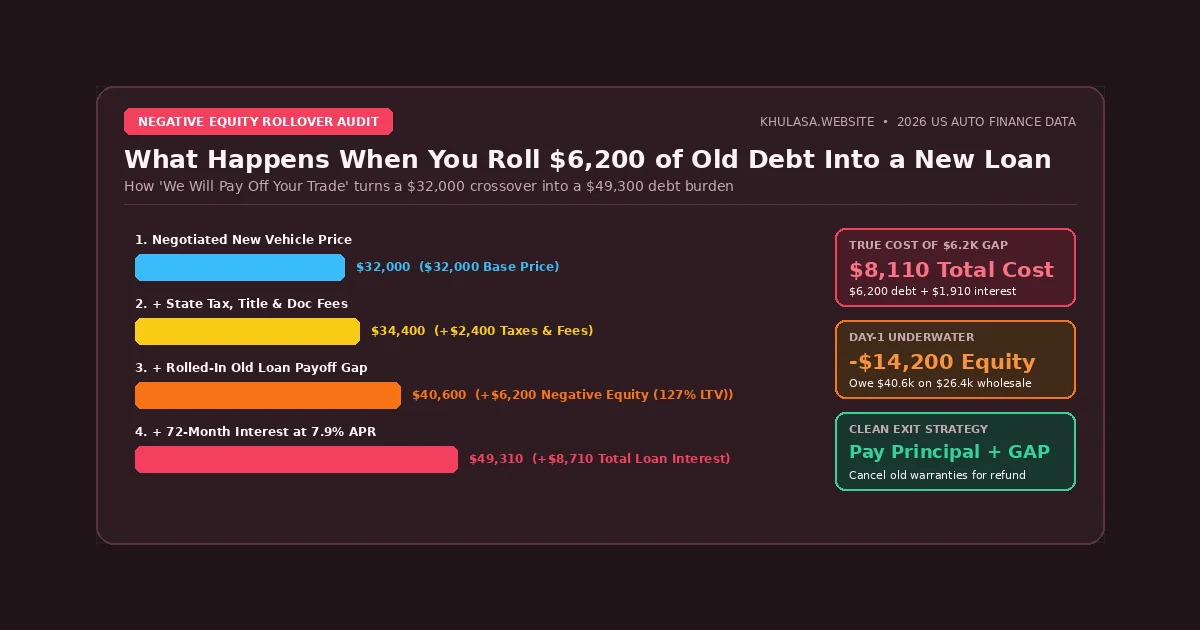
The average underwater trade-in at US franchise dealerships now carries more than $6,200 in unpaid loan balance from the buyer's previous vehicle. Every holiday weekend, radio and social media ads repeat the most seductive slogan in automotive retail: "No matter what you owe on your current trade-in, we will pay it off in full!"
To be completely candid, that slogan is a costly financial illusion. Dealerships never forgive a single penny of your old loan deficit. Under the federal Truth in Lending Act (Regulation Z) itemization rules enforced by the Consumer Financial Protection Bureau (CFPB) and consumer alerts from the Federal Trade Commission (FTC) on Auto Trade-Ins and Negative Equity, the dealer pays off your old lender and adds 100% of that shortfall ("Prior Credit or Lease Balance" minus "Trade-In Allowance") straight onto the principal balance of your new loan.
Case Study: Watching a $6,200 Negative Equity Rollover Snowball Into $11,400
Suppose a buyer purchased a midsize SUV three years ago on an 84-month loan with $0 down. Today, the buyer's 10-day loan payoff quote is $26,200, while the dealership appraises the SUV's wholesale trade-in value at $20,000, leaving −$6,200.00 in negative equity (you can test your own exact numbers in our Car Trade-In Value / Equity Calculator).
Frustrated by a $595 monthly payment and looming 60,000-mile tire and brake expenses, the buyer trades the underwater SUV in on a new $34,000 crossover with $0 cash down in a state with a 7% sales tax and $650 in fees:
- Negotiated New Car Price:
$34,000.00 - Sales Tax (7% on $14,000 net difference after $20k trade credit):
+$980.00 - Title, Registration & Dealer Doc Fees:
+$650.00 - Rolled-In Negative Equity From Old Loan:
+$6,200.00 - Total New Amount Financed: $41,830.00 on a car with a $34,000 MSRP!
Look at what happens the moment the buyer signs that $41,830 loan contract: the new $34,000 crossover immediately drops to its Day-1 wholesale value of roughly $30,400, while the buyer owes $41,830. In a single afternoon, the buyer's negative equity has exploded from −$6,200 to −$11,430! Worse yet, because the loan's Loan-to-Value (LTV) ratio sits at 123% of MSRP, the lender adds a 1.00% high-LTV risk surcharge to the interest rate (bumping a 6.50% Prime loan up to 7.50% APR over 72 months). Across 72 months at 7.50% APR, that rolled-in $6,200 shortfall adds $107.20 per month ($7,718.40 in principal and interest) plus an extra $1,210 in rate-markup interest on the base car, costing $8,928.40 total.
Comparison of 4 Legal Exit Strategies When You Are $6,200 Underwater
Instead of rolling $6,200 into a 72-month loan on another depreciating vehicle, compare the net financial cost of four smarter exit routes:
| Exit Strategy | How the Math Works | Out-of-Pocket Cash Needed Now | Net Cost of Clearing the $6,200 Shortfall | Equity Position in 36 Months |
|---|---|---|---|---|
| Option 1: Keep Car & Add $200/Mo Principal Curtailment | Keep current vehicle 18–24 more months while paying an extra $200/mo directly to principal | $200 / mo incremental | $0 wasted (Saves ~$1,100 in existing loan interest) | +$4,500 to +$6,500 Positive Equity |
| Option 2: Private-Party Sale + Personal Credit Union Bridge | Sell car privately for retail (~$23,200 vs $20,000 trade-in), cutting deficit from $6,200 to $3,000; pay $3,000 cash or 24-mo credit union note | $3,000 cash (or $138/mo for 24 mo) | $3,000 ($3,200 recovered via private sale spread!) | 100% Debt-Free on old vehicle |
| Option 3: 36-Month Subsidized EV/Hybrid Lease "Wash" | Use a $5,000–$7,500 factory lease rebate to absorb the $6,200 negative equity over a strict 36-month lease | $0–$1,000 at signing | ~$1,500–$2,400 (after factory lease cash offset) | $0.00 Clean Slate at Month 36 turn-in |
| Option 4: Roll $6,200 Into a New 72-Month Auto Loan | Finance $41,830 at 123% LTV and 7.50% APR over 72 months | $0 at signing | $8,928 in extra principal + high-LTV interest | Still −$3,800 Underwater at Month 36 |
How to Sell a Car Privately When Your Bank Still Has the Title (Electronic Lien Release)
The bank always collects first. Still, you are not trapped at the dealership. Many underwater borrowers assume they cannot sell their car privately because their lender holds the title. That assumption costs them $3,000. In practice, thousands of lien-encumbered private sales happen every week using one of two straightforward procedures:
- In-Branch Bank or Credit Union Closing: If your loan is with a local credit union or national bank with local branches (such as Chase, Bank of America, PNC, or Wells Fargo), call the branch ahead of time so they have the title or electronic lien release ready. Meet your buyer inside the bank lobby; the buyer hands the teller a cashier's check for the agreed sale price (e.g. $23,200), you pay the remaining $3,000 shortfall at the counter to bring the payoff to $26,200, and the bank notarizes the bill of sale and mails/transmits the lien release directly to the buyer's DMV.
- Instant Retail Bidders (CarMax, Carvana, AutoNation) + Certified Check for the Difference: Even if you don't want to deal with private buyers on weekends, CarMax and Carvana frequently bid $1,500 to $2,800 higher than a traditional franchise dealer's initial trade-in pencil. If CarMax offers $22,400 on your $26,200 payoff, you simply bring a cashier's check for the $3,800 difference to the CarMax business office, walk out completely free of the loan in 30 minutes, and negotiate your next purchase as a clean cash/pre-approved buyer using our Car Loan Calculator.
Step Zero Before You Sell: Cancel Old Warranties and GAP for a Principal Reduction
Before writing a check to cover negative equity or rolling a dollar of old debt forward, pull the original Finance & Insurance (F&I) folder from when you bought your current vehicle. Look for three optional addendums: an Extended Service Contract (extended warranty), a Prepaid Maintenance Plan, or a Dealership GAP Waiver.
Every one of those contracts can be canceled in writing at any time for a pro-rata refund of the unused term and mileage. When you still have an active loan balance, the administrator sends that $900 to $2,400 refund check directly to your auto lender as a principal curtailment. We regularly see readers cut a $6,200 negative-equity gap down to $4,100 in three weeks simply by canceling an unused $2,800 dealership extended warranty before selling the car.