
Every time you prepare to replace your vehicle, you face a fundamental financial choice: Do you hand the keys to the dealership for a 20-minute trade-in appraisal, or do you detail the interior, take twenty photos, and sell it yourself to a private buyer? Conventional wisdom says dealerships "steal" trade-ins at wholesale prices, leaving thousands of dollars on the table.
That is often true—on average, the spread between a dealer's wholesale trade-in offer and a clean private-party sale sits between 12% and 18% ($2,200 to $3,800 on a $20,000 car). However, three real-world variables can shrink that gap to almost nothing: your state's trade-in sales tax credit, reconditioning and inspection deductions, and whether you still have an active bank lien on the title.
Before you decide whether dealing with weekend test-drive strangers is worth your time, let's walk through the exact net-proceeds math. You can run your own vehicle value and local tax rate directly in our Trade-In Sales Tax Savings Calculator and verify your final purchase sheet in our Out-the-Door (OTD) Price Calculator.
Why Dealerships Offer $2,500 to $4,000 Less Than Retail
When a used-car manager appraises your trade-in, they aren't trying to insult you; they are working backward from what your car would cost them to buy at a wholesale Manheim or ADESA dealer auction, minus the cost to make it retail-ready on their front line. Here is the typical internal dealer worksheet on a clean 4-year-old crossover that retails on their lot for $23,500:
- Expected Front-Line Retail Selling Price: $23,500
- Minus Shop Reconditioning & Safety Inspection: -$1,150 (two tires, front brake pads, oil service, windshield chip repair, and full detail)
- Minus Lot Holding Costs, Advertising & Sales Commission: -$850
- Minus Target Dealership Gross Profit Margin: -$2,000
- Maximum Dealer Trade-In Offer: $19,500
As a private seller, you don't have lot overhead or salesperson commissions, and private buyers rarely expect brand-new tires or a dealership warranty. That lets you price your car right in the middle—say, $21,800—giving the private buyer a $1,700 discount off dealer retail while pocketing an extra $2,300 yourself.
The Hidden Equalizer: How State Trade-In Sales Tax Credits Change the Math
Here is where geography completely changes the answer. In 42 U.S. states (including Texas, Florida, New York, Pennsylvania, Georgia, Illinois, and Washington), when you trade in a vehicle at the same dealership where you buy your replacement car, you only pay auto sales tax on the net price difference between the new car and your trade-in allowance.
In California, Virginia, Hawaii, and Washington D.C., there is zero trade-in sales tax credit—you pay full sales tax on the entire purchase price of the new car regardless of whether you trade in a vehicle. Meanwhile, a few states (like Michigan, Ohio, and Maryland) apply caps or specific new-vs-used rules (for instance, Ohio gives a full trade-in tax credit only when buying a new vehicle, not a used one).
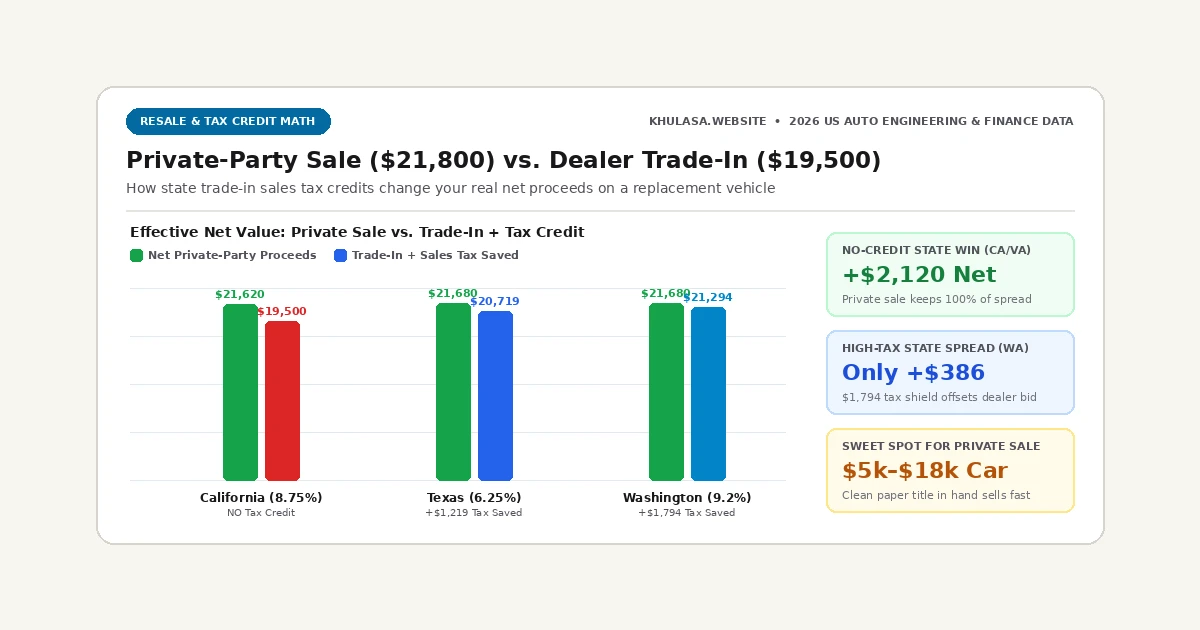
Let's compare the exact net cash difference on that same crossover ($19,500 dealer trade-in offer vs. $21,800 private-party sale) across three different states:
| Financial Line Item | Scenario A: California (8.75% Tax, NO Trade-In Credit) | Scenario B: Texas (6.25% Motor Vehicle Tax, Full Credit) | Scenario C: Washington State (9.2% Auto Tax, Full Credit) |
|---|---|---|---|
| Private-Party Selling Price | $21,800 | $21,800 | $21,800 |
| Minus Detailing, Listing Ads & Smog/Inspection | -$180 | -$120 | -$120 |
| Net Proceeds From Private Sale | $21,620 | $21,680 | $21,680 |
| Dealer Trade-In Offer | $19,500 | $19,500 | $19,500 |
| Plus Sales Tax Saved on New Car ($19,500 × Tax Rate) | +$0 (No credit in CA) | +$1,219 | +$1,794 |
| Effective Total Value of Dealer Trade-In | $19,500 | $20,719 | $21,294 |
| True Net Profit of Selling Privately | +$2,120 (Big Win) | +$961 (Moderate Win) | +$386 (Barely Worth the Hassle) |
Look at Scenario C in Washington State (or parts of Illinois, New York, Kansas, and Arizona where combined state and local auto tax rates hit 8.5% to 10.25%): trading the car in for $19,500 instantly saves you $1,794 in sales tax on your new car, making that $19,500 trade-in offer worth $21,294 in real purchasing power. Selling privately for $21,800 only nets you an extra $386 after detailing—meaning you would spend three weekends answering "Is this still available?" messages and meeting strangers in bank parking lots just to clear $386.
In contrast, if you live in California or Virginia (or if you are selling a car outright without buying another one), the dealer trade-in gives you zero tax shield. Selling privately puts the full $2,120+ straight into your bank account.
The Lien Payoff Hurdle: Why Selling Privately Above $25,000 Is Harder
Price bracket and title status also dictate which route works best:
- Vehicles Worth $4,000 to $18,000 With a Clean Paper Title in Hand: This is the golden sweet spot for private-party sales. Millions of cash buyers and credit-union shoppers search daily for reliable, well-maintained cars under $18,000. If you hold the physical paper title free of liens and have a folder of maintenance receipts, your car will often sell within 7 days for $2,500 to $3,500 more than a dealer wholesale bid.
- Vehicles Worth $25,000+ With an Active Bank Loan (Lien on Title): As the Consumer Financial Protection Bureau (CFPB) notes, when a bank holds an electronic lien on your title, you cannot simply sign the title over to a private buyer on Saturday afternoon. Unless your lender has a local branch where you and the buyer can meet at the teller window, you must either pay off the loan out of your own savings 2–3 weeks before listing the car, or use an escrow service (like Keysavvy or Caramel) to handle the payoff and title transfer. If you owe more than the car is worth, calculate your payoff gap first in our Negative Equity & Underwater Loan Calculator.
4 Steps to Maximize Your Payout Whichever Route You Choose
- Get 3 Instant Cash Bids Before Stepping Onto a Dealer Lot: Before negotiating your new car purchase, take 15 minutes online to pull binding 7-day buy bids from CarMax, Carvana, and a local EchoPark or AutoNation store. That highest written cash offer is now your absolute floor.
- Separate the New Car Price From the Trade-In Until the End: As FTC dealer buying guidelines emphasize, never negotiate a monthly payment that mixes your trade-in and new car together. Agree on the Out-the-Door price of the new car first, then ask the dealer to match your written CarMax/Carvana bid so you capture the state sales tax credit on top.
- Always Meet Private Buyers Inside the Buyer's Bank Branch: Never accept personal checks, Venmo/Zelle transfers, or envelopes of unverified cash on the street, and never pay for a "vehicle history report website" sent to you by an online stranger (a classic phishing scam). Meet inside the buyer's bank branch, watch the teller print the cashier's check or wire transfer, complete the federal odometer disclosure statement, and file your state's online Release of Liability the same hour.
- Compare State Sales Tax Rules First: Check our full state-by-state breakdown in Car Sales Tax and Trade-In Credit Rules by State and watch out for hidden dealership contract charges in Dealer Doc Fees and Bogus Add-Ons by State.