
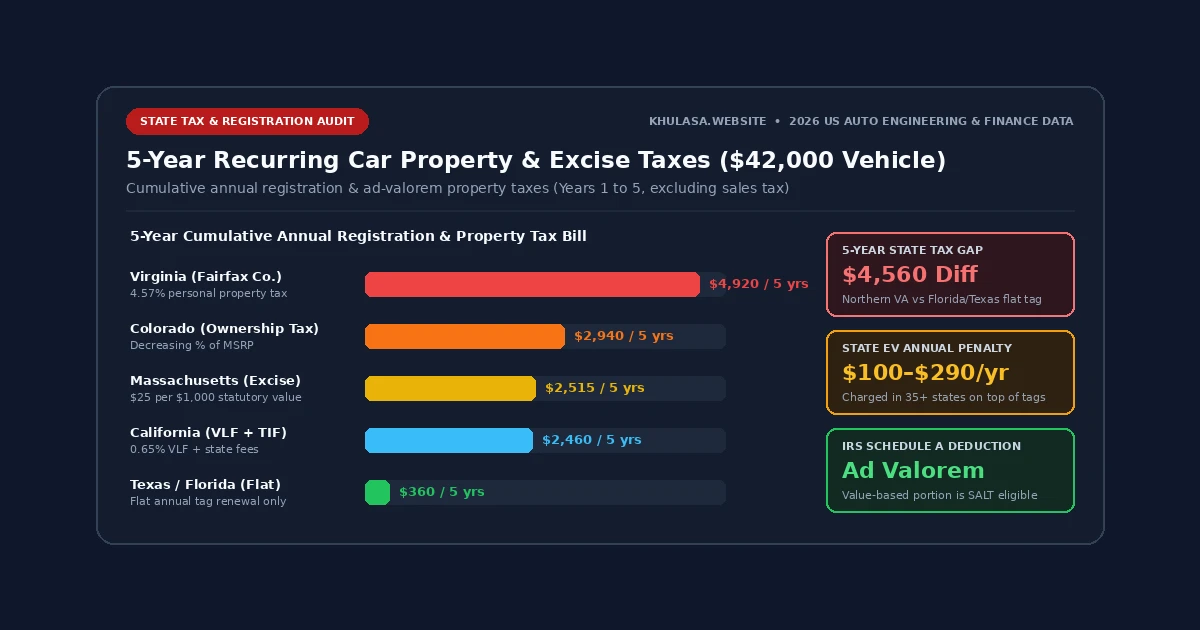
Most car buyers think vehicle taxes end the day they sign the dealership finance contract and write a check for the state sales tax. If you live in Florida, Texas, Ohio, Pennsylvania, or New York, that is largely true: your annual license plate renewal is a flat administrative fee ranging from $36 to $95 per year regardless of whether you drive a $12,000 Honda Civic or a $95,000 Porsche.
Move across state lines into one of the 26 U.S. states that levy an annual personal property tax, motor vehicle excise tax, or value-based (ad valorem) registration fee, and you are in for a rude shock in your mailbox every single year. In jurisdictions like Northern Virginia, Connecticut, Massachusetts, Missouri, South Carolina, California, and Colorado, owning a $45,000 vehicle triggers a recurring annual tax bill between $550 and $1,750 in Year 1—falling only gradually as the vehicle depreciates.
Even more important for electric and hybrid shoppers: over 35 states now charge an extra annual EV registration penalty of $100 to $290 on top of standard plate fees to replace lost state gas tax revenue. Let's break down how recurring vehicle property taxes work, how to include them in our Cost Per Mile Calculator, and how they contrast with upfront purchase taxes in our Out-the-Door Price Calculator.
How Value-Based (Ad Valorem) Annual Car Taxes Are Calculated
States that tax vehicles annually generally use one of two statutory formulas:
- Local Personal Property Tax Based on Trade-In/Clean Loan Book Value (e.g., Virginia, Connecticut, Missouri, South Carolina, Kentucky): Your county or municipal tax assessor looks up your car's VIN in the J.D. Power (NADA) or Kelley Blue Book valuation guide on January 1 (or October 1) of each year and multiplies that assessed value by the local millage or property tax rate.
- Statutory Depreciation Schedule Based on Original MSRP (e.g., Massachusetts, Colorado, California, Minnesota, Indiana): Rather than checking used-car market prices, the state takes your car's original factory Window Sticker MSRP and applies a fixed statutory percentage for Year 1, Year 2, Year 3, and so on. For example, under Massachusetts General Laws Chapter 60A, every town charges $25 per $1,000 of valuation, where a car is valued at 90% of MSRP in its first year, 60% in Year 2, 40% in Year 3, 25% in Year 4, and 10% in Year 5 and every year thereafter.
| State & Tax Structure | Year 1 Annual Tax + Plate Fee ($42,000 MSRP Vehicle) | Year 3 Annual Tax + Plate Fee | 5-Year Cumulative Registration & Car Property Tax | Additional Annual EV Surcharge (2026) |
|---|---|---|---|---|
| Virginia (Fairfax / Loudoun County) 4.15%–4.57% Personal Property Tax (with partial Car Tax Relief on first $20k) |
~$1,380 | ~$985 | ~$4,920 | +$128.14 / yr Highway Use Fee |
| Massachusetts (All Cities & Towns) $25 per $1,000 Excise Tax on statutory % of MSRP |
~$975 | ~$450 | ~$2,515 | $0 (Standard plate fee) |
| Colorado (Specific Ownership Tax) 2.1% of 85% MSRP in Yr 1, stepping down through Yr 10 |
~$845 | ~$495 | ~$2,940 | +$57.19 + Road Usage Charge |
| California (Vehicle License Fee — VLF) 0.65% of depreciated value + CHP & Transportation Improvement Fee |
~$565 | ~$445 | ~$2,460 | +$118+ Zero-Emission Vehicle (ZEV) Fee |
| Georgia (Title Ad Valorem Tax — TAVT) 7.0% One-Time TAVT at purchase; $0 annual property tax thereafter |
$20 (Flat tag renewal after upfront TAVT) | $20 | $100 (after purchase) | +$219.84 / yr Alternative Fuel Fee |
| Florida or Texas (Flat Registration States) Zero annual vehicle property tax; flat weight/class fee |
~$45 – $78 | ~$45 – $78 | ~$225 – $390 | +$200 / yr in Texas (EV penalty) |
The $5,000 5-Year Gap: Why High-MSRP Cars Get Punished Twice
Look closely at the 5-year cumulative column above. If you buy a $42,000 SUV in Texas or Florida, your total registration renewals over five years come out to roughly $350. Buy that exact same $42,000 SUV in Northern Virginia, Connecticut, or Colorado, and you will write checks totaling $2,900 to $4,900 over five years just for the legal right to keep license plates on the bumper.
Even more painful: if you lease a luxury vehicle in an annual personal property tax state, you do NOT escape the tax. Although the bank or automaker's captive finance company (e.g., BMW Financial Services or Toyota Financial Services) is the legal title owner of the leased vehicle, every lease contract contains a pass-through clause requiring the lessee to reimburse 100% of the annual county personal property or excise tax bill.
The 2026 State EV & Hybrid Registration Surcharge Wave
Because state highway maintenance funds rely heavily on per-gallon gasoline taxes (which average 28 to 58 cents per gallon depending on the state), over three dozen state legislatures have enacted annual surcharges on electric vehicles—and increasingly on conventional gas-burning hybrids—as tracked by the DOE Alternative Fuels Data Center.
Wait—does a $200 annual state EV registration fee fairly match what a gasoline driver pays in state gas taxes? Let's run the math:
- Suppose a typical driver travels 12,000 miles per year in a modern 32-MPG crossover, burning 375 gallons of gasoline annually.
- In Texas, the state motor fuel tax is $0.20 per gallon. That 32-MPG gasoline driver pays $75.00 per year in state gas taxes ($375 gallons × $0.20).
- Yet Texas charges an electric vehicle owner a flat $200 per year EV registration surcharge ($400 upfront when buying a new EV for a two-year tag)—equivalent to the gas tax paid by someone burning 1,000 gallons of gas (32,000 miles a year!).
In states like Georgia ($219+ EV fee), Ohio ($200 EV / $100 Hybrid fee), Washington ($225 total EV fees), and New Jersey ($250 rising to $290 EV fee), low-mileage EV commuters who only drive 6,000 to 8,000 miles a year pay two to three times more in state road taxes than an equivalent gasoline car. Be sure to enter your state's annual EV surcharge when comparing vehicles in our EV vs. Gas Total Cost Calculator.
Can You Deduct Annual Car Property Taxes on Your Federal Tax Return?
According to IRS Topic No. 503 (Deductible Taxes), if you itemize deductions on Schedule A (Form 1040) and have not yet hit your State and Local Tax (SALT) cap, you can deduct the value-based (ad valorem) portion of your annual vehicle registration or personal property tax—provided the fee is charged annually and calculated strictly as a percentage of the vehicle's value (not its weight or flat plate fee). Flat registration fees and weight-based truck fees are not deductible for personal vehicles.
For a complete state-by-state breakdown of upfront purchase taxes, see our companion guide on Car Sales Tax and Trade-In Credit Rules by State and check proven ways to lower your annual car ownership costs.