
Last quarter, while auditing two nearly identical Toyota Highlander buyer's orders submitted by readers in Dallas and Los Angeles, one tax line jumped off the page. Both households bought a $39,000 SUV and traded in a 2021 Honda CR-V appraised at $20,000. Under rules enforced by the Texas Comptroller of Public Accounts, the Dallas buyer paid 6.25% motor vehicle sales tax on only the $19,000 net difference: $1,187.50.Had that Dallas buyer sold the CR-V privately on Saturday and bought the Highlander with cash on Monday, the Texas tax bill would have been $2,437.50. Trading in at the dealership created an instant $1,250.00 tax reduction.
Cross the state line into California or Virginia, and that tax shield vanishes. Under regulations administered by the California Department of Tax and Fee Administration (CDTFA), our Los Angeles County reader (facing a 9.50% combined state, county, and district tax rate) paid $3,705.00 in sales tax on the full $39,000 purchase price despite trading in a $20,000 vehicle. State law created a $2,517.50 tax gap on the exact same transaction.
How the Net-Difference Sales Tax Formula Works on a Buyer's Order
In the majority of US states that grant a full motor-vehicle trade-in tax credit, state revenue statutes treat a trade-in not as two separate transactions, but as a single property exchange where sales tax applies strictly to the net cash boot (the negotiated price of the replacement vehicle minus the gross allowance given for your trade-in).
Read that phrase gross trade-in allowance twice. One of the most valuable and misunderstood rules in American auto taxation is that your sales tax credit is calculated on your vehicle's full trade-in appraisal value, completely independent of your remaining loan payoff. Even if you owe $16,000 on a vehicle that the dealership appraises at $20,000 (leaving you with $4,000 in net equity in our Car Trade-In Value / Equity Calculator), a full-credit state subtracts the entire $20,000 trade-in allowance from the new car's taxable price before computing sales tax.
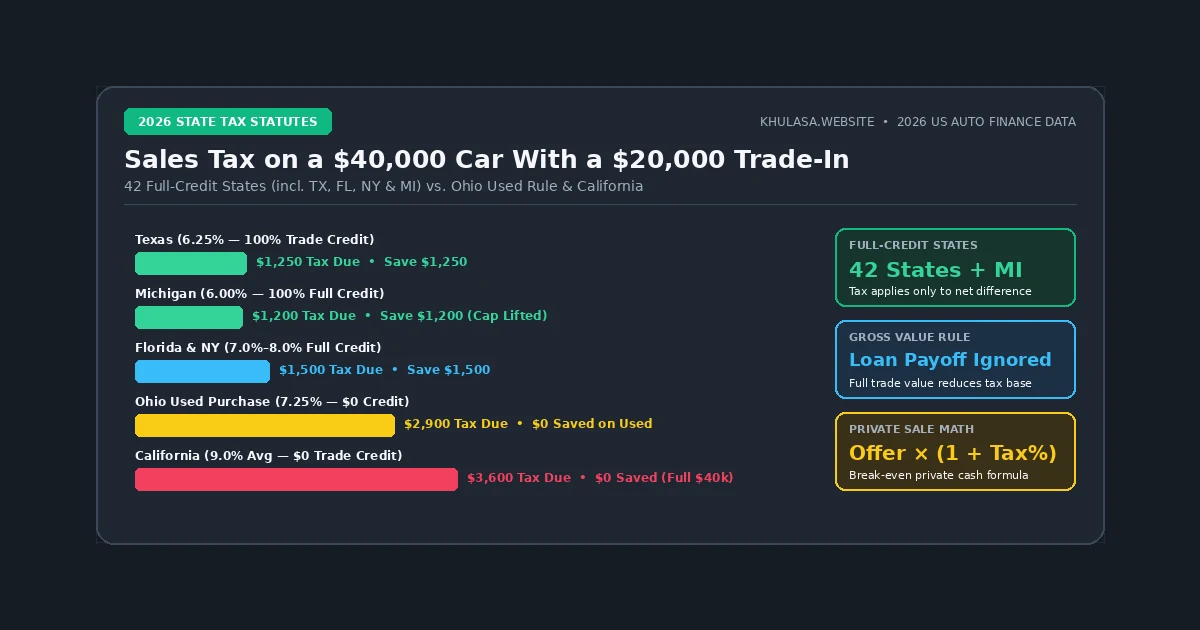
2026 State-by-State Trade-In Sales Tax Rules: Full Credit (Including Michigan's Eliminated Cap), Ohio's New-Only Rule, and Zero-Credit States
Before deciding whether to list your car on a private marketplace or trade it in at the dealership, verify how your state's Department of Revenue treats a $40,000 replacement vehicle with a $20,000 trade-in in 2026:
| State Category & 2026 Examples | Trade-In Tax Credit Rule (2026 Statutes) | Taxable Base ($40k Car / $20k Trade) | Typical Combined Tax Rate | Sales Tax Due | Tax Saved by Trading In |
|---|---|---|---|---|---|
| Full-Credit States (43 States in 2026) TX, FL, NY, PA, IL, MI, GA, AZ, WA, NJ, NC, CO, MA |
100% of gross trade-in value deducted from taxable price (New & Used motor vehicles) | $20,000 | 7.00% avg (6.25% TX / 6.0% MI / 8.5% NY) | $1,400 ($1,200 in MI) | $1,400 saved ($1,200 in MI) |
| Michigan 2025/2026 Statutory Update Michigan (MCL § 205.51(d)(xiv)) |
Annual phase-in cap completed: 100% Full Credit on motor vehicles (cap remains only on watercraft/boats) | $20,000 (Cars/Trucks) | 6.00% state | $1,200 | $1,200 saved (Uncapped on cars!) |
| New-Vehicle-Only Credit State Ohio (ORC § 5739.01) |
100% credit when buying a brand-new vehicle; $0 credit when buying a used vehicle | $20,000 (New) $40,000 (Used) |
7.25% avg | $1,450 (New) $2,900 (Used) |
$1,450 (New) $0 (Used) |
| Zero-Credit States California, Virginia, Hawaii, Kentucky (used rules), Washington D.C. |
No trade-in deduction allowed on standard retail purchases; full purchase price is taxed | $40,000 | 9.00% (CA avg) 4.15% (VA) |
$3,600 (CA) $1,660 (VA) |
$0 saved |
| No-Sales-Tax / Flat-Fee States Oregon, Montana, New Hampshire, Delaware, Alaska |
0% state sales tax (DE charges 4.25% doc fee, which does allow a 100% trade-in credit!) | N/A ($20k DE) | 0.00% (4.25% DE fee) | $0 ($850 DE) | $0 ($850 saved in DE) |
Why Old Online Guides Get Michigan Wrong: The MCL § 205.51 Phase-Out
If you search older automotive forums, you will still see people claiming that Michigan caps its motor vehicle trade-in sales tax credit at $6,000, $8,000, or $10,000. That cap is gone for cars and trucks. Under Michigan Compiled Laws (MCL) § 205.51(d)(xiv), the legislature enacted a scheduled phase-out that increased the motor-vehicle trade-in exemption by $1,000 every January 1 until the cap was completely eliminated on motor vehicles (providing a 100% full trade-in credit on cars, trucks, and SUVs in 2025 and 2026). Under current Michigan law, only titled watercraft (boats) remain subject to a statutory dollar trade-in cap.
The Break-Even Equation: Dealership Trade-In vs. Private-Party Sale
Used-car managers know the exact sales tax rate in their ZIP code and use that tax shield to justify offering you a lower wholesale trade-in figure. In Houston, Tampa, or Detroit, a desk manager will circle the tax savings on the worksheet and say: "Sure, we are offering you $19,000 for your Subaru Outback while you might get $20,100 on Facebook Marketplace, but with our sales tax credit, $19,000 from us puts the exact same money in your pocket without strangers coming to your house."
In that specific scenario, the desk manager is right. You can test any dealer trade-in offer against a private sale in ten seconds with one formula:
Break-Even Private Sale Price = Dealer Trade-In Offer × (1 + Combined Sales Tax Rate)
Suppose a dealership in Seattle, Washington (where state plus Regional Transit Authority sales tax reaches 10.25%) offers you $22,000 for your trade-in. Multiplying $22,000 × 1.1025 shows that a private buyer must pay you at least $24,255 in cash just for you to break even after paying an extra $2,255 in dealership sales tax. If private buyers are paying $26,000, the private sale wins by $1,745. If private buyers are only offering $23,800, taking the dealer's $22,000 trade-in leaves more cash in your bank account.
Three Fine-Print Traps That Void Your Trade-In Tax Credit
Even in full-credit states like Texas, Florida, New York, Michigan, and Illinois, three common transaction structures will cost you the entire tax offset:
- Selling to CarMax or Carvana in a Separate Transaction: In almost every state (aside from a few states like Missouri and Arkansas that permit a short window to apply a private-sale Bill of Sale credit), the trade-in and the replacement purchase must appear on the exact same retail installment contract at the same dealership. Selling your old car to CarMax on Tuesday and buying a new Ford at a franchise dealer on Thursday triggers sales tax on 100% of the new vehicle's price.
- Trading In a Leased Vehicle When the Bank Holds Title: Because the captive leasing bank is the legal title owner on a lease, trading a leased vehicle into a third-party dealership often forfeits the full sales tax credit unless state rules specifically credit positive lease equity.
- Ohio's Used-Car Rule (ORC § 5739.01): Under Ohio Revised Code § 5739.01(H)(2), Ohio grants a 100% trade-in tax credit only when the vehicle you are buying is brand-new. Trade a $22,000 car toward a $34,000 two-year-old Certified Pre-Owned SUV in Columbus (7.50% tax), and you pay $2,550 in tax on the full $34,000. Buy a brand-new $34,000 SUV across the showroom floor, and your tax drops to $900 ($1,650 saved). Run both numbers in our Monthly Car Payment Calculator and Car Registration & Tax Calculator, and read our audit on how dealers pad the fee column on out-the-door contracts.