
Open the owner's manual of almost any 2026 crossover, sedan, or pickup truck, and the "Normal Service" maintenance schedule will tell you that full-synthetic motor oil (typically 0W-20 or 0W-16) only needs to be drained every 10,000 miles or 12 months. Meanwhile, the jug of synthetic oil on the auto parts shelf brags about 15,000-mile protection.
Ask an independent master technician who actually tears down modern Toyota, Honda, Hyundai, Ford EcoBoost, or Volkswagen engines after their 60,000-mile powertrain warranty expires, and you will hear a remarkably different story. Across independent repair bays, 10,000-mile oil drain intervals are the single most common denominator behind stuck oil control rings, stretched timing chains, and failed variable valve timing (VVT) phasers between 85,000 and 120,000 miles.
Let's look at the engineering and financial math behind why automakers stretched maintenance intervals in the first place—and why spending an extra $85 a year on 5,000-mile oil changes is the highest-return insurance policy in automotive ownership. You can model your own preventive service budget in our Car Maintenance & Repair Reserve Calculator.
Why Automakers Pushed 10,000-Mile Intervals (Hint: It Wasn't for Your 150k-Mile Longevity)
Full-synthetic base oils (Group III hydrocracked synthetics and Group IV polyalphaolefins) are genuinely superior to 1990s conventional mineral oil. As AAA's laboratory testing confirmed, synthetic oil outperforms conventional oil by an average of 47% across shear stability, cold-cranking viscosity, and volatility resistance. Synthetic base stock does not thermally break down at 3,000 miles.
However, base oil thermal breakdown is not why modern engines destroy their own oil. Automakers stretched published drain intervals to 10,000 miles for three corporate incentives that have nothing to do with how your engine runs at 130,000 miles:
- "Free" Scheduled Maintenance Marketing: When brands include 2 years / 24,000 miles or 3 years / 36,000 miles of complimentary dealer maintenance with a new car purchase, specifying a 10,000-mile interval means the manufacturer only has to reimburse dealers for two or three oil changes instead of five or seven. Across two million vehicles sold annually, that saves an automaker over $200 million in warranty reimbursement expenses.
- Third-Party Cost-of-Ownership Rankings: Consumer publications calculate 5-year "Cost to Own" awards using the manufacturer's "Normal" maintenance schedule. Halving the number of scheduled oil visits artificially lowers the vehicle's published 5-year maintenance score by $450 to $650.
- Powertrain Warranty Horizon: Most factory powertrain warranties end at 5 years or 60,000 miles. An engine run on 10,000-mile intervals will almost always survive to 60,000 miles without catastrophic failure; the oil consumption and timing chain symptoms only surface between 80,000 and 115,000 miles, long after the second owner is footing the bill.
The 3 Engineering Changes That Punish Oil in Modern Engines
Why could an older 2006 naturally aspirated port-injected V6 tolerate extended synthetic oil drains better than a 2026 1.5-liter turbocharged four-cylinder? Three mechanical changes designed to meet federal fuel economy standards fundamentally altered what happens inside your crankcase:
1. Low-Tension Piston Rings With Microscopic Oil Drain Holes
Friction between the piston rings and cylinder walls accounts for roughly 20% of internal engine friction. To boost EPA highway ratings by 1 to 1.5 MPG, engineers replaced stiff, high-tension oil control rings with ultra-thin, low-tension "wafer" rings punctured by tiny oil return slots. If soot and oxidized oil varnish sit in the crankcase for 9,000 to 10,000 miles, those microscopic return holes carbon up. Once the oil control ring sticks in its piston groove, it can no longer scrape oil off the cylinder walls during the combustion stroke. The engine begins burning a quart of oil every 1,200 miles—poisoning the catalytic converter in the process.
2. Gasoline Direct Injection (GDI) and Fuel Dilution
In a port-injected engine, gasoline sprays onto the back of the hot intake valve, vaporizing before it enters the cylinder. In a Direct Injection (GDI) engine, gasoline sprays directly into the combustion chamber at 2,500+ PSI. On cold mornings and short errands, liquid fuel condenses on the cold cylinder liners and washes past the piston rings directly into your oil pan. By 6,500 miles of suburban driving, a GDI turbo engine's 0W-20 oil often contains 3% to 5% raw unburned gasoline—shearing its viscosity down to a 0W-12 and stripping its anti-wear zinc/molybdenum film.
3. Roller Timing Chains and Hydraulic VVT Phasers
Older engines used wide single-row or double-row roller chains—or rubber timing belts that didn't touch engine oil at all. Modern overhead-cam engines use long, narrow silent-link timing chains lubricated by pinhole oil jets, alongside hydraulic camshaft phasers with fine mesh screens. Soot particles suspended in dirty oil act like liquid lapping compound inside the thousands of tiny pin-and-bushing joints of a timing chain, causing the chain to elongate ("stretch") and throw camshaft correlation fault codes (like P0011 or P0016).
The 100,000-Mile Math: $850 "Saved" vs. $4,500 at Risk
Let's run the exact dollar math over 100,000 miles (roughly 7 to 8 years of driving) assuming an average full-synthetic oil and filter change costs $85 at an independent shop or dealership service lane.
| Maintenance Metric (0 to 100,000 Miles) | 5,000-Mile / 6-Month Severe Interval | 10,000-Mile / 12-Month "Normal" Interval | Net Financial Difference |
|---|---|---|---|
| Total Oil & Filter Changes Over 100k Miles | 20 Oil Changes | 10 Oil Changes | 10 Fewer Service Visits |
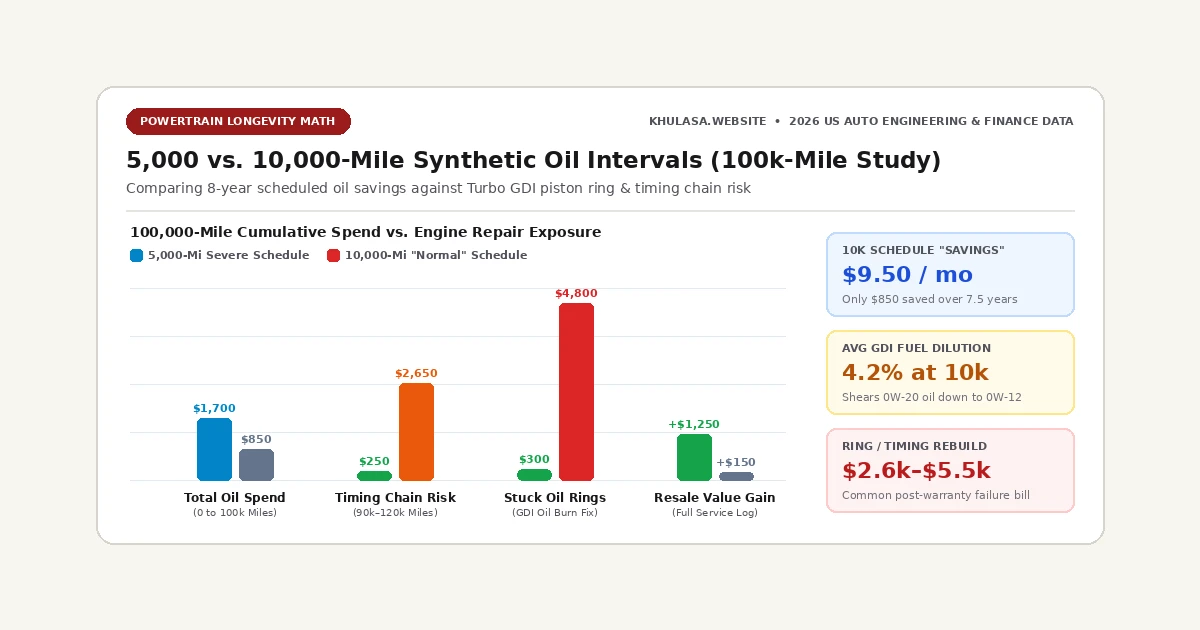
| Cumulative Oil Change Spend (@ $85/visit) | $1,700 | $850 | $850 Saved Over 7–8 Years (~$9.50/mo) |
| Average Used Oil Analysis Fuel Dilution at Drain | 1.1% – 1.8% (Safe Spec) | 3.2% – 5.4% (Viscosity Sheared) | 2.5x Higher Crankcase Contamination |
| Risk of Stuck Oil Rings / Burning >1 Qt per 1,500 Mi | Low (<3% before 150k miles) | High (18% – 30% on Turbo GDI engines) | $3,800 – $6,200 Short-Block / Ring Rebuild |
| Risk of Timing Chain Stretch / VVT Phaser Replacement | Low (Typically lasts 160k+ miles) | Elevated (Common at 90k – 120k miles) | $1,900 – $3,400 Timing Job |
| Private-Party Resale Value Impact (Documented Service Log) | Commands +$800 to +$1,500 buyer premium | Standard wholesale book value | Recoups 100% of extra oil cost at sale |
Look at the third row of that table: stretching your oil changes from 5,000 miles to 10,000 miles saves you $850 over nearly eight years of driving—about $9.50 per month, orless than three gallons of gas. In exchange for saving $9.50 a month, you expose a $35,000 vehicle to a $2,500 timing chain replacement or a $5,000 piston-ring teardown once it crosses 90,000 miles.
Check the Fine Print: Almost Everyone Drives in "Severe Service"
If you flip two pages past the "Normal Schedule" in your owner's manual, every automaker prints a "Severe / Special Operating Conditions" schedule that cuts the recommended oil drain interval in half—back to 5,000 miles or 6 months. According to manufacturer definitions, you fall under Severe Service if your driving includes any of the following:
- Repeated short trips of less than 5 miles in normal temperatures, or less than 10 miles in freezing temperatures (where the oil temperature never stays above 212°F long enough to boil off condensation and fuel vapor).
- Extensive idling, stop-and-go rush-hour traffic, or school pickup lines.
- Driving in dusty, mountainous, salty, or extreme hot/cold environments.
- Towing a trailer, using a rooftop cargo carrier, or carrying heavy commercial loads.
Over 80% of American suburban commuters meet at least two of those Severe Service criteria every single week. Only a highway sales rep who starts their car once in the morning and cruises 150 uninterrupted miles at 65 mph truly qualifies for the 10,000-mile schedule. To see how preventive maintenance protects your vehicle's equity, check our Car Depreciation Calculator and read our guide on why "lifetime" transmission fluid is an equally expensive myth.