
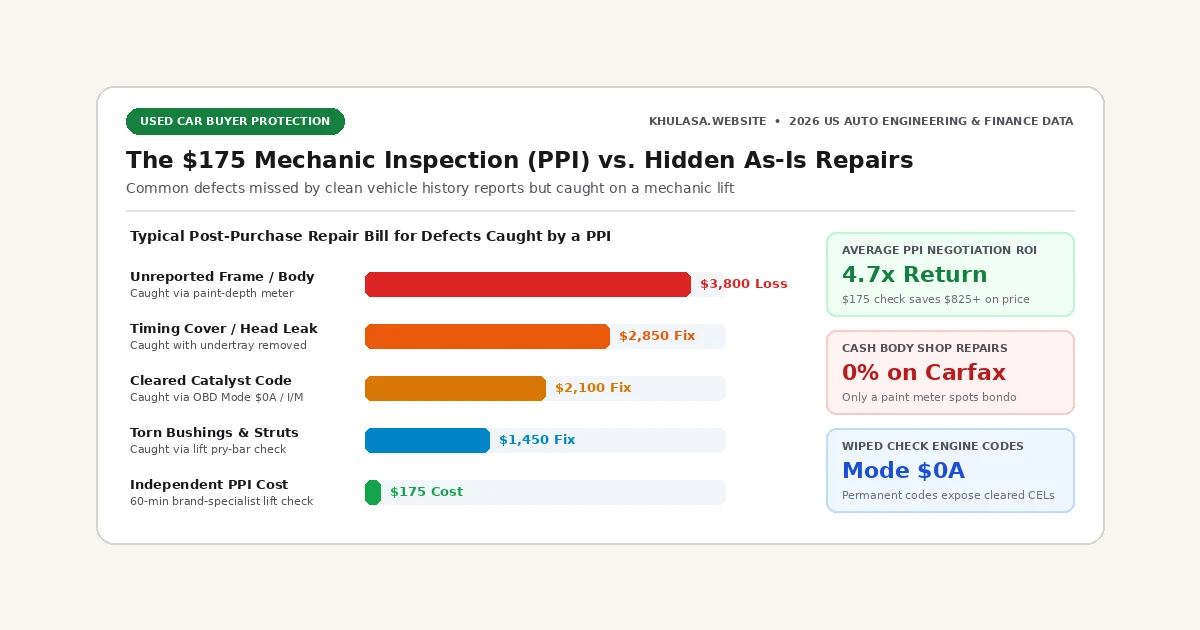
Walk onto any used car lot in America and express hesitation about a vehicle's mechanical condition, and the salesperson will immediately slide a glossy printed Carfax or AutoCheck report across the desk: "Look right here—One Owner, Zero Accidents Reported, Clean Title!"
For millions of buyers, that green checkmark ends their due diligence. They sign the FTC Buyers Guide stamped "AS IS — NO DEALER WARRANTY", finance the car for 60 months, and discover three weeks later that the transmission shudders once hot, the catalytic converter code was cleared right before the test drive, and the rear quarter panel is packed with body filler from an unreported cash body-shop repair.
A commercial vehicle history report is a useful first filter—alongside checking the federal National Motor Vehicle Title Information System (NMVTIS) for salvage brands and NHTSA.gov/recalls for open safety recalls—but a database printout can only tell you what was reported to an insurance database or police precinct. It cannot look underneath a rusted subframe or read live OBD-II readiness monitors. Let's look at why spending $150 to $220 on an independent Pre-Purchase Inspection (PPI) is the single smartest move in used-car buying, and how you can use PPI findings to negotiate your final price in our Out-the-Door Price Calculator.
3 Massive Traps That a "Clean" History Report Never Sees
1. The Unreported Cash / Fleet Collision Repair
Suppose a driver slides their leased SUV into a concrete parking garage pillar, or a rental car company crunches a bumper and rear door on one of its own fleet vehicles. Because rental fleets are self-insured and private owners often pay an independent body shop $3,200 out of pocket to avoid a 40% insurance rate hike, neither the police nor an insurance carrier is ever notified. The vehicle is repaired with cheap aftermarket panels, traded in two months later, and receives a spotless "No Accidents Reported" badge on every commercial history report.
2. The Cleared Check Engine Light (Unset OBD-II Readiness Monitors)
When a failing $2,100 catalytic converter (code P0420) or a stretched timing chain (code P0016) illuminates the yellow Check Engine Light, any unscrupulous seller with a $19 Bluetooth code reader can hit "Erase Codes" ten minutes before you arrive. The dashboard warning light turns off immediately—and on many vehicles, the fault code will not re-trigger until the car completes two full cold-to-hot highway drive cycles (often 60 to 120 miles after you drive it home).
How does a mechanic catch this in 10 seconds? When codes are erased, the engine computer resets all of its internal emissions self-tests (Catalyst, EVAP, O2 Sensor, Misfire) to "INC" (Incomplete / Not Ready), and since 2010, OBD-II computers also store "Mode $0A Permanent Fault Codes" that cannot be erased by any scan tool until the car's computer itself verifies that the defective part was fixed.
3. Deferred Maintenance & Subframe Rust
A history report tells you when the previous owner got a $49 oil change, not what the technician recommended that the owner declined. When an owner learns at 78,000 miles that their car needs $1,100 in tires, $850 in front/rear brakes, $1,400 in leaking control-arm bushings and struts, and a $1,600 timing belt/water pump service—totaling $4,950 in immediate maintenance—their most common reaction is to trade the car in that weekend without fixing a single item.
| Hidden Defect / Deferred Item | Caught by Clean History Report? | Caught by $175 Mechanic Lift Inspection (PPI)? | Typical Repair Cost After You Buy "As-Is" | How the Mechanic Detects It |
|---|---|---|---|---|
| Recently Cleared Check Engine Codes (Catalytic Converter / Evap) | No | Yes (100% of the time) | $1,400 – $2,800 | Scans OBD-II Mode $06 / Mode $0A Permanent Codes & Mileage Since DTC Cleared |
| Unreported Collision / Repainted Panels | No (If paid in cash or fleet-repaired) | Yes | -$2,500 to -$4,500 Diminished Value | Digital paint-depth gauge (factory paint is 4–6 mils; repainted bondo is 12–35+ mils) |
| Seeping Head Gasket / Timing Cover / Rear Main Oil Leak | No | Yes | $1,800 – $3,900 | Removes plastic undertray on hydraulic lift; checks with UV dye & block tester |
| Worn Control Arm Bushings, Ball Joints, Struts & Brakes | No | Yes | $1,200 – $2,400 | Pry-bar suspension load check on lift; micrometer brake rotor thickness measurement |
| Severe Undercarriage / Subframe Road-Salt Rust | Rarely (Only tells you state of registration) | Yes | $2,500+ or Unsafe Frame | Inspects pinch welds, brake lines, rear subframe mounts, and exhaust flanges on lift |
How a $175 PPI Pays for Itself Even When the Car Is Good
Many shoppers think a Pre-Purchase Inspection only saves money if the mechanic finds a catastrophic engine problem and tells you to walk away. In reality, 80% of PPIs pay for themselves on the very car you end up buying.
Suppose you inspect a clean $18,500 sedan and the independent mechanic reports: "Engine and transmission are healthy, no paintwork, no cleared codes—but the rear brake pads are at 3mm ($420), the front lower control arm compliance bushings are torn ($680), and the 12V battery failed our load test ($240)."
Instead of buying the car at $18,500 and getting hit with a $1,340 repair bill at your first service visit, you hand the mechanic's printed inspection sheet to the seller or dealership manager and say: "I'm ready to buy the car today, but we need to either have your shop replace the rear brakes, battery, and bushings on the Due Bill, or knock $1,000 off the price." Your $175 inspection fee just netted you a $825 instant discount—and you can budget the remaining future service items in our Car Maintenance Reserve Calculator.
What to Do If a Dealership Says "We Don't Allow Off-Site Inspections"
According to the Federal Trade Commission's Used Car Rule, every dealer must post a Buyers Guide window sticker that explicitly asks whether you are allowed to take the vehicle off the lot for an independent inspection. If a used-car dealer refuses to let a local independent shop (within 5 miles of the dealership) put the car on a lift, you have two choices:
- Hire a Licensed Mobile Pre-Purchase Inspector to Come to the Lot: Mobile inspection specialists bring portable hydraulic jacks, factory-level bidirectional OBD-II tablets, digital paint-thickness gauges, and borescopes directly to the dealership parking lot. (If a dealer refuses even an on-lot mobile mechanic inspection, walk out immediately—they are hiding something major.)
- Use a 7-Day Return Window for a Post-Purchase Lift Inspection: If you buy from a retailer with a written no-questions-asked 5-to-10-day return policy (such as CarMax or Carvana), book a full lift inspection at your trusted brand-specialist mechanic for the morning after delivery. If the mechanic uncovers hidden frame damage, rust, or transmission problems, hand the keys right back inside the return window for a 100% refund.
Once your mechanic gives the car a clean bill of health, make sure you don't lose your savings in the finance office by reviewing our guide on dealer doc fees and bogus add-ons to refuse and comparing financing rates in our Auto Loan Calculator.