
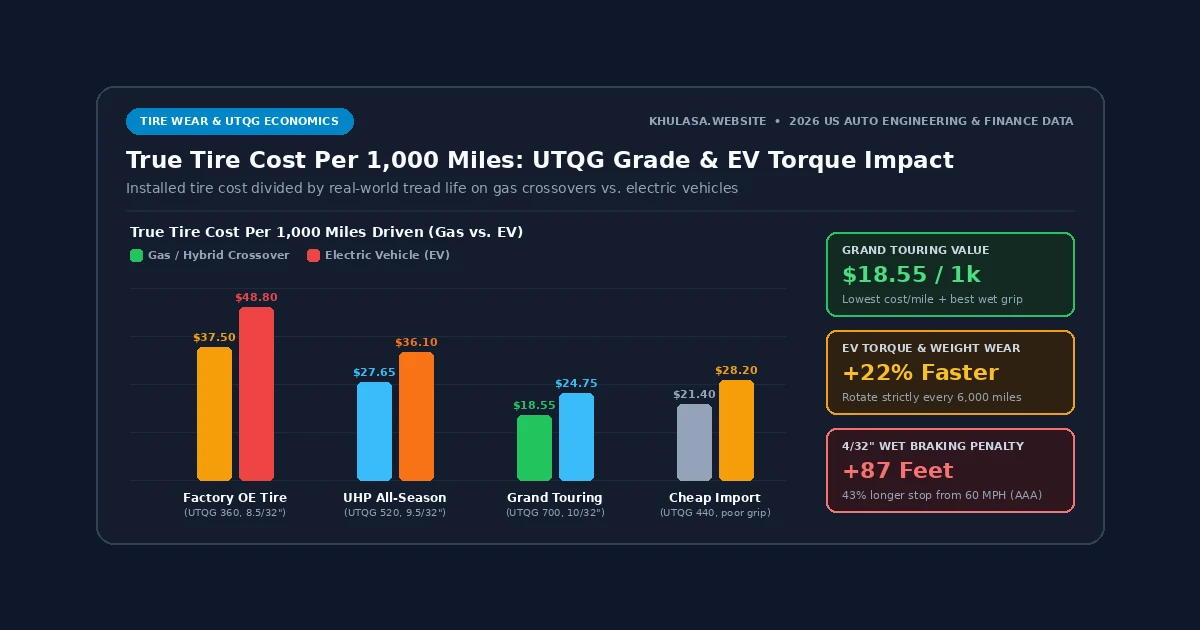
After fuel and depreciation, rubber is the single fastest-burning consumable on a modern car. Walk into a tire shop today to replace the 19-inch or 20-inch tires that come standard on mainstream family crossovers like a Honda CR-V Touring, Toyota Highlander, or Tesla Model Y, and the out-the-door bill with mounting, road-force balancing, TPMS service kits, and alignment easily crosses $1,050 to $1,450.
To soften that sticker shock, tire manufacturers plaster bold "60,000-Mile" or "80,000-Mile Treadlife Warranty" badges across the display rack. Yet millions of drivers are stunned when their mechanic measures their tread depth at 32,000 miles and tells them they are already down to 3/32 of an inch. Why do modern tires wear out so much faster than their marketing claims—and how do you actually calculate which tire delivers the lowest cost per mile?
Using federal NHTSA Uniform Tire Quality Grading (UTQG) standards and stopping-distance tests from AAA Automotive Engineering, let's break down the math behind tire longevity. You can plug your own tire replacement cycle into our Cost Per Mile Calculator and Car Maintenance Reserve Calculator.
What the Sidewall UTQG Treadwear Number Actually Means
Molded into the sidewall of every passenger tire sold in the United States is a federal UTQG code that looks something like TREADWEAR 640 TRACTION A TEMPERATURE A. Under NHTSA regulations, that three-digit Treadwear number is established by running the candidate tire around a 400-mile federal test loop in West Texas alongside a government-standardized Course Monitoring Tire rated at 100.
In theory, a tire rated 600 lasted six times longer on the Texas test loop than the government control tire. In the real world, there are two huge caveats every buyer needs to know:
- Manufacturers Grade Their Own Tires (Within Federal Rules): While NHTSA defines the test procedure and audits compliance, each tire manufacturer assigns the UTQG grade for its own product lines. Consequently, you can directly compare a Michelin 640-rated tire against a Michelin 800-rated tire, but a 600 rating from a budget off-brand import does not reliably outlast a 540 rating from Continental, Bridgestone, or Michelin.
- OEM Factory Tires Are Engineered for MPG, Not Tread Life: Have you ever noticed that the brand-new factory tires on a new lease car wear out by 24,000 miles? Automakers order custom "OE-spec" versions of name-brand tires molded with softer, thinner tread depth (often starting at 8.5/32" instead of 10.5/32") to shave rolling resistance by 2% for the EPA fuel economy test and deliver a quiet test-drive on the dealer lot. Furthermore, OEM tires mounted on brand-new cars almost never carry a mileage treadwear warranty!
| Tire Category & Typical UTQG Grade | Installed Price (Set of 4, 18"–19") | Realistic Gas/Hybrid Lifespan | Realistic EV / Heavy SUV Lifespan | True Tire Cost Per 1,000 Miles (Gas vs. EV) |
|---|---|---|---|---|
| Factory OE-Spec Tire (New Car Delivery) UTQG 300 – 440 (Starts at 8.5/32" depth) |
$1,050 (Replacement price) | 24,000 – 32,000 Miles | 18,000 – 25,000 Miles | $37.50 / $48.80 per 1k mi |
| Ultra-High Performance All-Season UTQG 500 – 560 (Starts at 9.5/32" depth) |
$1,120 | 36,000 – 45,000 Miles | 28,000 – 34,000 Miles | $27.65 / $36.10 per 1k mi |
| Grand Touring All-Season / All-Weather UTQG 640 – 740 (Starts at 10/32" depth) |
$1,040 | 50,000 – 62,000 Miles | 38,000 – 46,000 Miles | $18.55 / $24.75 per 1k mi |
| Ultra-Cheap Budget Import Tire UTQG 420 – 500 (Hard compound, poor wet grip) |
$620 | 26,000 – 32,000 Miles | 20,000 – 24,000 Miles | $21.40 / $28.20 per 1k mi |
Notice the sweet spot in the table above: a top-tier Grand Touring All-Season or 3-Peak Mountain Snowflake All-Weather tire (UTQG 640–740) costing $1,040 installed actually delivers a lower cost per 1,000 miles ($18.55) than a $620 bargain-basement tire ($21.40)—while stopping up to 22 feet shorter on wet pavement.
Why Electric Vehicles and 3-Row SUVs Eat Tires 25% Faster
If you drive an electric vehicle or a heavy plug-in hybrid SUV, your tires face a double mechanical penalty:
- Curb Weight (+700 to +1,200 Pounds): A battery pack adds roughly 900 pounds of mass compared to an equivalent combustion car. Higher vertical load increases friction in every corner and highway on-ramp.
- Instant Zero-RPM Electric Torque & Regenerative Braking: A gas engine builds torque gradually as RPMs climb past 3,000 RPM. An electric motor delivers 100% of its peak torque at 0 MPH the split-second you press the accelerator—and then applies heavy regenerative braking torque back through the driven wheels every time you lift your foot.
Together, extra weight and instant bidirectional torque scrub tread blocks roughly 20% to 28% faster unless you practice gentle acceleration off the line and rotate your tires strictly every 6,000 miles.
How a 0.25-Degree Toe Misalignment Destroys $1,100 Tires in 12,000 Miles
Most drivers assume their wheel alignment is fine as long as the car drives straight when they let go of the steering wheel. That is a dangerous misconception. While off-center camber or caster will make a car pull to one side, equal front toe-in or toe-out misalignment will let the car track perfectly straight down the interstate while dragging both front tires sideways by 15 to 25 feet for every single mile you drive.
Hitting a single winter pothole or parking curb can knock a front tie-rod out of spec by just 0.20 degrees. Over 12,000 miles, that invisible sideways scrubbing shaves the inner or outer shoulder of your front tires down to the steel belts while the center tread still has 7/32" remaining. Spending $110 for a 4-wheel laser alignment whenever you mount new tires—and asking for the printed before-and-after degree sheet—protects the entire $1,100 investment.
The Tire Mileage Warranty Catch-22 (And How to Beat It)
Why do so few drivers successfully claim a prorated credit when their "65,000-mile" tires wear out at 38,000 miles? Because tire manufacturer warranties contain three strict conditions in the fine print:
- The tread must be worn down evenly to 2/32" across all grooves: If the inner shoulder is bald at 2/32" while the center is at 5/32", the manufacturer will deny the claim for "mechanical misalignment." Moreover, as AAA wet-track testing proved, waiting until 2/32" in wet or snowy states is unsafe—at 4/32" tread depth, wet stopping distances from 60 mph already increase by 43% (87 extra feet).
- You must show documented proof of tire rotations every 6,000 to 7,500 miles: If you rotated your tires at home in the driveway without shop invoices, or skipped a 15,000-mile stretch, the warranty claim is void.
- Staggered Wheel Setups Cut the Warranty in Half: If your performance sedan or SUV uses wider rear tires than front tires (meaning they cannot be rotated front-to-back), tire manufacturers automatically cut the mileage warranty by 50% (e.g., from 60,000 miles to 30,000 miles) on the rear axle.
Pro tip: Buy your tires from a retailer that includes free lifetime rotations (such as Discount Tire / America's Tire or Costco) and let them log every 6,000-mile rotation in their own computer system. When those tires hit 3/32" or 4/32" early, the store manager already has your complete rotation history on screen and will apply a 30% to 45% prorated credit directly toward your next set. For more on how tires affect fuel burn, read our guide on tire pressure and aerodynamic highway MPG penalties.