
Pop the hood of almost any car built after 2016 and look for the transmission dipstick. In 90% of modern sedans, crossovers, and trucks, it isn't there. Where a bright yellow or red dipstick tube used to sit, there is now a bolted metal plug stamped with a warning: "Sealed Unit — No Dipstick — Lifetime Fluid — Do Not Service Under Normal Conditions."
That single piece of marketing jargon—"Lifetime Fluid"—has cost American car owners hundreds of millions of dollars in premature transmission replacements between 75,000 and 115,000 miles. Just like extended 10,000-mile engine oil intervals, calling transmission fluid "lifetime" allows automakers to delete a $250 to $350 service from their published 5-year Cost-of-Ownership tables while knowing full well that the factory powertrain warranty expires at 60,000 miles.
Ironically, if you look up the maintenance manual from ZF Friedrichshafen or Aisin—the actual German and Japanese engineering companies that manufacture the 8-speed and 10-speed automatic transmissions used inside BMW, Ram, Jeep, Audi, Toyota, and Lexus vehicles—the transmission builder explicitly instructs owners to change that exact same fluid every 50,000 to 60,000 miles (and every 30,000 to 40,000 miles for CVTs). You can budget for these critical milestone services using our Car Maintenance & Repair Reserve Calculator.
Why CVTs Destroy Their Fluid Twice as Fast as Geared Automatics
As explained by the U.S. Department of Energy's transmission engineering guide, a Continuously Variable Transmission (CVT) does not use meshing steel gears to shift ratios. Instead, a traditional belt-or-chain CVT (used in most Nissan, Subaru, Honda, and Mitsubishi models) uses a high-strength steel push-belt or link chain clamped tightly between two variable-diameter conical pulleys (variators).
Think about the physics happening inside that case: metal is literally pressing against smooth metal cones under massive hydraulic clamping pressure to transmit 180+ horsepower without slipping. What keeps that steel belt from either slipping (which instantly scores and ruins the pulley faces) or welding itself to the cones? Specialized CVT fluid containing microscopic traction-coefficient modifiers and anti-wear additives.
Every mile you drive, intense shear forces and heat (often exceeding 210°F in summer traffic or hill climbing) chop up those long-chain viscosity polymers and suspend microscopic metallic wear particles in the fluid. Once CVT fluid oxidizes and loses its precise hydraulic pressure viscosity around 45,000 to 60,000 miles, the variator hydraulic solenoids stick, clamping pressure drops for a split second, and the steel belt slips across the pulley face—shaving metal ribbons into the valve body and triggering the dreaded "CVT judder."
Why CVTs Cannot Be Cheaply Rebuilt Like Older Automatics
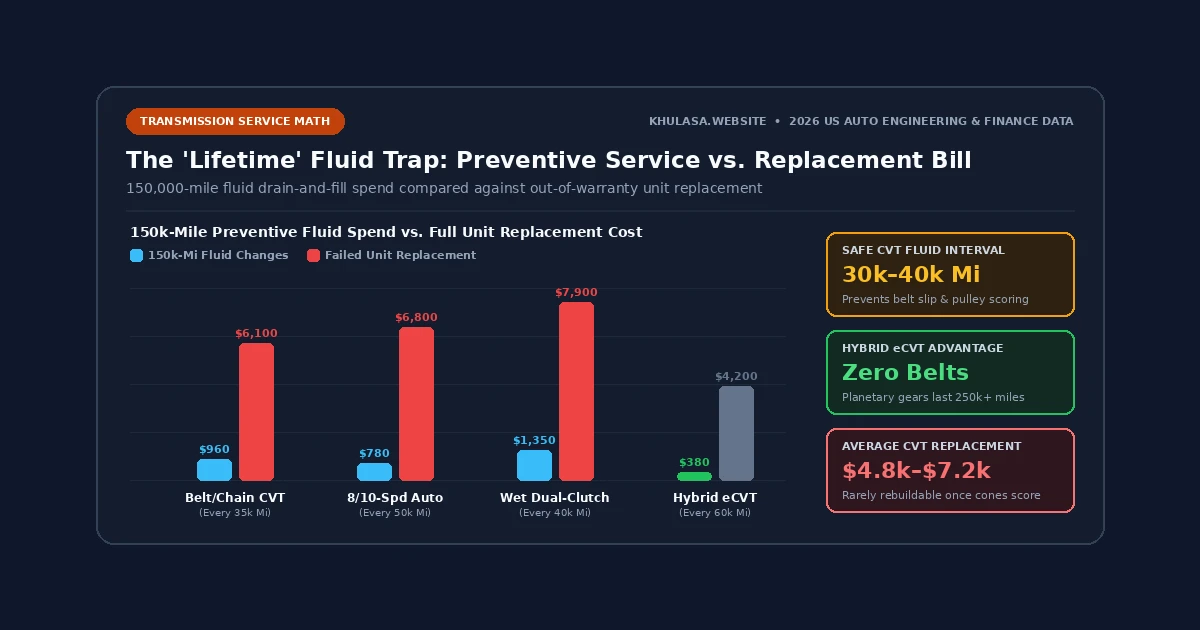
When a traditional 4-speed or 6-speed planetary automatic transmission wore out in 2008, a local transmission shop could pull it out, install a $450 master clutch pack and seal kit, and put you back on the road for $2,200. With modern CVTs and complex 9-to-10-speed automatics, many manufacturers do not even sell internal variator cones, push-belts, or calibrated mechatronic valve bodies as individual service parts—or the labor and calibration risk exceeds the price of a factory remanufactured assembly. As hundreds of owner reports in the NHTSA powertrain complaints database show, a failed CVT almost always requires a complete unit replacement costing $4,800 to $7,200.
| Transmission Type & Common Vehicles | Safe Real-World Fluid Service Interval | Drain-and-Fill Service Cost | Out-of-Warranty Replacement Cost | 150,000-Mile Fluid Maintenance Cost vs. Risk |
|---|---|---|---|---|
| Belt / Chain CVT (Nissan Rogue/Altima/Sentra, Subaru Outback/Forester/Crosstrek, Honda Civic/CR-V 1.5T) |
Every 30,000 – 40,000 Miles | $210 – $320 (OEM CVT fluid required) | $4,800 – $7,200 | $960 total in fluid changes prevents a $6,000 unit failure |
| 8-, 9-, or 10-Speed Geared Automatic (Ford F-150/Explorer, GM trucks, Toyota Camry/RAV4 gas, BMW/Ram ZF 8HP) |
Every 50,000 – 60,000 Miles | $260 – $480 (Includes pan filter on ZF units) | $5,200 – $8,500 | $750 total in fluid changes prevents valve body & torque converter failure |
| Dual-Clutch Transmission (Wet DCT / DSG) (VW GTI/Golf R, Audi, Hyundai/Kia wet-DCT, Porsche PDK) |
Every 40,000 Miles (Strict) | $350 – $650 (Fluid + high-pressure cartridge filter) | $6,000 – $10,500 | Skipping the 40k service ruins mechatronic solenoids |
| Hybrid Planetary eCVT (Toyota Prius/RAV4 Hybrid/Camry Hybrid, Ford Escape/Maverick Hybrid, Honda two-motor Hybrid) |
Every 60,000 – 80,000 Miles | $140 – $220 (Simple 4-quart gravity drain & fill) | $3,500 – $5,500 (Rarely fails) | No belts, pulleys, or clutches; most durable transmission on the road |
Important Distinction: Why a Toyota Hybrid "eCVT" Is NOT a Belt CVT
Shoppers often avoid Toyota, Lexus, Ford, or Honda hybrids because the spec sheet lists an "eCVT" (Electronically Controlled Continuously Variable Transmission). Mechanically, a hybrid eCVT shares zero parts with a belt-and-pulley CVT. A Toyota or Ford hybrid eCVT is a solid steel planetary gearset (similar to a differential) coupled to two electric motor-generators—with no steel push-belt, no variable pulleys, no torque converter, and no friction clutch packs to wear out. That is why hybrid eCVTs routinely surpass 300,000 miles in New York City taxi fleets with nothing more than a simple $160 four-quart WS fluid drain-and-fill every 60,000 miles.
Drain-and-Fill vs. High-Pressure Machine Flush: Never Let a Quick-Lube "Flush" Your Transmission
When you take your car in for transmission service, the single most important phrase to use at the service desk is: "I want a gravity drain-and-fill (and pan filter replacement if equipped) using exact OEM fluid—NOT a machine power flush."
Here is why: Many chain repair shops promote high-pressure transmission flush machines that hook into your cooler lines and pump generic multi-vehicle ATF plus chemical cleaning solvents through the transmission. In an older transmission with 85,000+ miles, a high-pressure flush can dislodge fine clutch silt from the bottom of the pan and force it straight into the microscopic hydraulic passages of the valve body solenoids—causing the transmission to slip within weeks of leaving the shop. Even worse, using "universal" fluid plus a friction-modifier additive bottle inside a Nissan NS-3, Subaru Lineartronic, or Honda HCF-2 CVT will alter the belt clamping friction coefficient and void your warranty rights under FTC Magnuson-Moss warranty rules.
A simple gravity drain-and-fill replaces roughly 45% to 60% of the fluid in the system (since the rest remains inside the torque converter), replenishes the depleted anti-wear and anti-foaming additive package safely, and disturbs zero internal debris. To see how transmission longevity impacts your long-term vehicle budget, check our Cost Per Mile Calculator and read our companion guide on 5,000-mile vs. 10,000-mile synthetic engine oil intervals.