
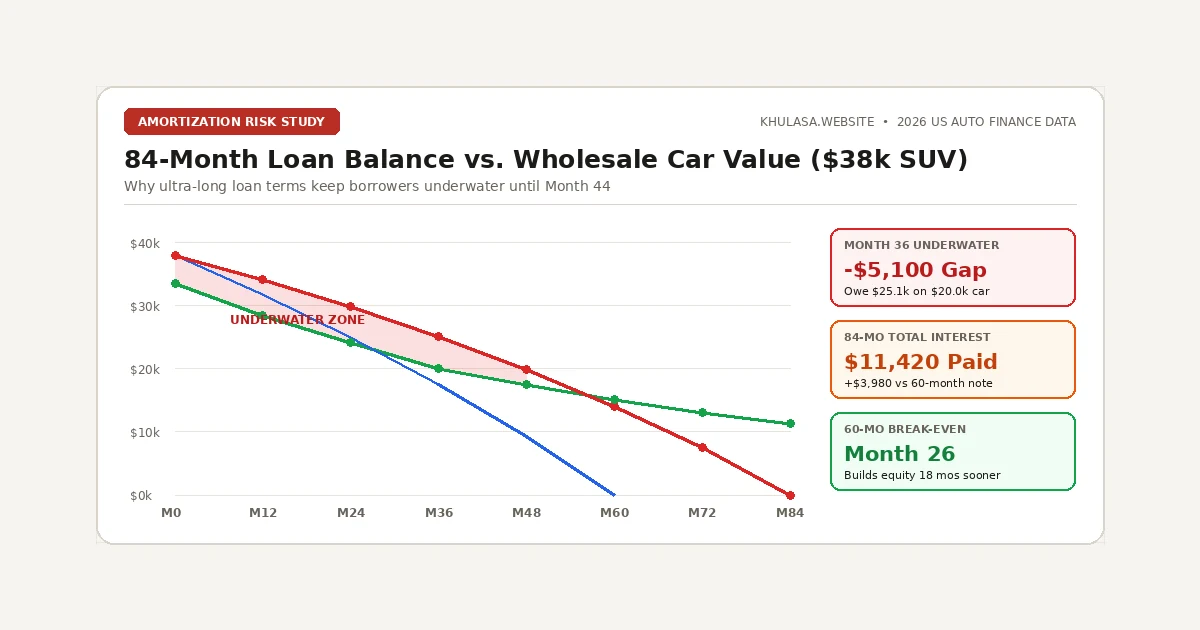
More than 68% of financed new-vehicle originations in the United States now stretch between 72 and 84 months. Eight-year 96-month notes are even showing up on half-ton pickup trucks. When I ask dealership finance managers how a household earning $78,000 a year drives home in a $44,000 midsize SUV on a Saturday afternoon, they point to a single box on their computer screen: 84 months.
The monthly payment pitch feels painless at the desk. Stretching a $38,000 balance from 60 months to 84 months drops the monthly draft from $744 to $585. That frees up $159 a month in immediate cash flow. Here is the catch. Dealership four-square worksheets never show the collision between slow principal amortization and steep early-life vehicle depreciation. Research published by the Consumer Financial Protection Bureau (CFPB) and Federal Reserve G.19 Consumer Credit releases confirms that borrowers on 72- and 84-month terms pay significantly higher APRs and enter negative equity traps at record rates.
The Collision Between Amortization Math and Wholesale Depreciation
That math rarely holds up over time. A new passenger vehicle loses value fastest during its first 36 months on the road, dropping roughly 8% to 11% the day it is titled as a used car and averaging a 14% to 16% compound annual decline thereafter. An amortizing auto loan behaves in the exact opposite way: because monthly interest is calculated on the remaining unpaid principal balance, your earliest payments are heavily weighted toward interest, and principal reduction crawls during the first two years.
Dealers know this trick well. Lenders never offer the same interest rate across all loan terms. Because longer terms expose banks to higher default rates and lower collateral recovery values, credit unions and captive lenders typically add a 0.45% to 0.75% rate premium when stepping from 60 to 72 months, and a 0.95% to 1.35% rate premium when stepping from 60 to 84 months.
Side-by-Side Audit: Financing $38,000 Across 48, 60, 72, and 84 Months
Let's model a real transaction using our Car Loan Calculator and Car Depreciation Calculator: a buyer purchases a new $40,000 Honda CR-V Hybrid or Subaru Outback Touring, puts $2,000 cash down (which barely covers state sales tax and registration fees, leaving $38,000.00 financed), and drives 13,500 miles per year (15% annual compound wholesale depreciation):
| Loan Metric | 48-Month Loan (6.15% APR) | 60-Month Loan (6.50% APR) | 72-Month Loan (7.05% APR) | 84-Month Loan (7.60% APR) |
|---|---|---|---|---|
| Monthly Payment | $895.07 / mo | $743.51 / mo | $648.88 / mo | $584.79 / mo |
| Total Interest Paid Over Term | $4,963.16 | $6,610.88 | $8,719.29 | $11,122.42 |
| Total Principal + Interest Paid | $42,963.16 | $44,610.88 | $46,719.29 | $49,122.42 |
| Loan Payoff Balance at Month 24 (Car Wholesale Value: ~$27,100) |
$20,175.40 (+$6,925 Equity) |
$24,358.10 (+$2,742 Equity) |
$27,212.65 (−$113 Underwater) |
$29,294.18 (−$2,194 Underwater) |
| Loan Payoff Balance at Month 36 (Car Wholesale Value: ~$23,035) |
$10,398.15 (+$12,637 Equity) |
$16,797.82 (+$6,237 Equity) |
$21,235.44 (+$1,800 Equity) |
$24,491.30 (−$1,456 Underwater) |
| Month Buyer Finally Reaches $0 Equity | Month 11 | Month 19 | Month 25 | Month 41 (3.4 Years!) |
Read the 84-month column carefully: the buyer pays $11,122.42 in interest, $4,511.54 more than the 60-month buyer and $6,159.26 more than the 48-month buyer, and remains underwater on the vehicle for the first 41 consecutive months of ownership. If a vehicle with a steeper 18.5% depreciation rate (such as a luxury sedan or electric crossover) is financed with $0 down for 84 months, the borrower stays upside down until Month 54 (four and a half years).
What Happens in Months 48 to 84: Double-Paying for Loan Payments and Out-of-Warranty Repairs
Most mainstream automakers (Ford, Chevrolet, Toyota, Honda, Subaru, Mazda) provide a basic bumper-to-bumper factory warranty that expires at 36 months or 36,000 miles, and a powertrain warranty that expires at 60 months or 60,000 miles. When you sign an 84-month auto loan, you are legally committing to pay $584.79 every month during Years 6 and 7 while the vehicle has zero factory warranty coverage and between 70,000 and 100,000 miles on the odometer.
During Years 6 and 7, the vehicle predictably requires its second set of tires ($950), front and rear brake rotors and pads ($850), spark plugs and coolant service ($550), and suspension struts or a water pump ($1,100). A household that needed an 84-month loan just to afford the $585 monthly payment rarely has $2,500 in liquid cash when a repair bill hits in Month 68. Out of desperation, they trade the aging vehicle in while still owing $10,800 on the 84-month loan, rolling negative equity into their next car. Read our companion breakdown on how rolled-in negative equity snowballs across multiple vehicles.
The 60-Month Litmus Test Before You Sign
Before accepting a 72- or 84-month financing offer at a dealership, apply one non-negotiable rule: plug the out-the-door amount financed into our Monthly Car Payment Calculator at a 60-month term. If the 60-month payment pushes your car budget beyond 10% to 12% of your monthly income in our Car Affordability Calculator, the problem is not the loan term, the problem is that the vehicle itself is $6,000 to $10,000 too expensive for your current cash flow. Stepping down one trim level or choosing a 2-year-old Certified Pre-Owned equivalent saves both the $8,000 upfront price difference and $4,500 in long-term financing interest.
Why Prepaying a 72-Month Loan Rarely Works in Real Life
Buyers often defend a 72- or 84-month contract with a comforting promise. They tell themselves they are only taking the seven-year term for "flexibility" and plan to send an extra $175 toward principal every month to pay it off in five years. In our own testing of reader loan ledgers, fewer than one in ten borrowers actually stick to that plan past Month 6.
There are two reasons this strategy fails. First, banks charge a 0.50% to 1.35% higher interest rate on an 84-month note than on a 60-month note from Day 1. Even if you pay extra principal, your interest rate remains locked at the higher 84-month tier. Second, household budgets expand to consume available cash. Once the automatic draft is set at $585, that extra $160 quietly disappears into groceries, subscriptions, or dining out.
How to Escape an Existing 84-Month Loan Without Rolling Debt
If you are already 18 or 24 months into an 84-month auto loan, resist the urge to trade the vehicle in for a new loan. Instead, check your current payoff balance against wholesale book value and apply a two-step refinance reset: pay down half of the negative equity gap over six months of targeted principal curtailments, then refinance the remaining balance into a 36- or 48-month credit union loan at a lower APR tier.