
Showroom window stickers make the electric-versus-gasoline math look like an effortless victory. At the US residential average of $0.16 per kilowatt-hour and 3.5 miles per kWh, electricity costs 4.6 cents per mile compared to 12.5 cents per mile for a 28 MPG crossover burning $3.50/gallon unleaded. Across 50,000 miles, that fuel gap promises $3,950 in automatic savings.
The real world is far more nuanced. When Elena and I audited four years of actual ownership receipts from EV drivers crossing the 50,000-mile mark, four non-fuel line items repeatedly surprised owners: a $1,380 invoice for four acoustic-foam HL-load EV tires at 28,000 miles, a $200 to $225 annual state EV registration surcharge ($400 upfront for two years on new Texas registrations), a six-month collision insurance policy that jumped $310 over their previous gas SUV, and highway DC fast-charging sessions billed at $0.48 to $0.58 per kWh. By cross-checking energy prices and state laws on the U.S. Department of Energy Alternative Fuels Data Center (AFDC) and FuelEconomy.gov, you can separate real EV savings from showroom hype.
The Two Charging Realities: Home Off-Peak Level 2 vs. Public DC Fast Charging
The single most important variable in electric vehicle economics is not which badge sits on the hood. It is whether you have a dedicated 240-volt Level 2 circuit in a private garage or driveway. When you charge at home on an overnight time-of-use (TOU) utility tariff in states like Texas, Florida, Washington, Georgia, or Ohio ($0.10 to $0.14/kWh), even after factoring in an 11% AC-to-DC onboard charger conversion loss, your true energy cost stays around $0.036 to $0.045 per mile.
Without home charging, the math flips completely. Drivers living in urban apartments who rely on public commercial DC Fast Charging stations (Electrify America, EVgo, or peak-hour Superchargers averaging $0.46 to $0.58/kWh) pay $0.145 to $0.175 per mile. At $0.52/kWh, an EV averaging 3.3 mi/kWh costs 15.8 cents per mile to fuel. That is more expensive per mile than driving a 22 MPG gasoline V6 SUV at $3.50/gallon, and nearly double the fuel cost of a 45 MPG Toyota Camry Hybrid (7.8 cents per mile).
50,000-Mile (4-Year) Operating Audit: Tesla Model Y / Equinox EV vs. Honda CR-V vs. RAV4 Hybrid
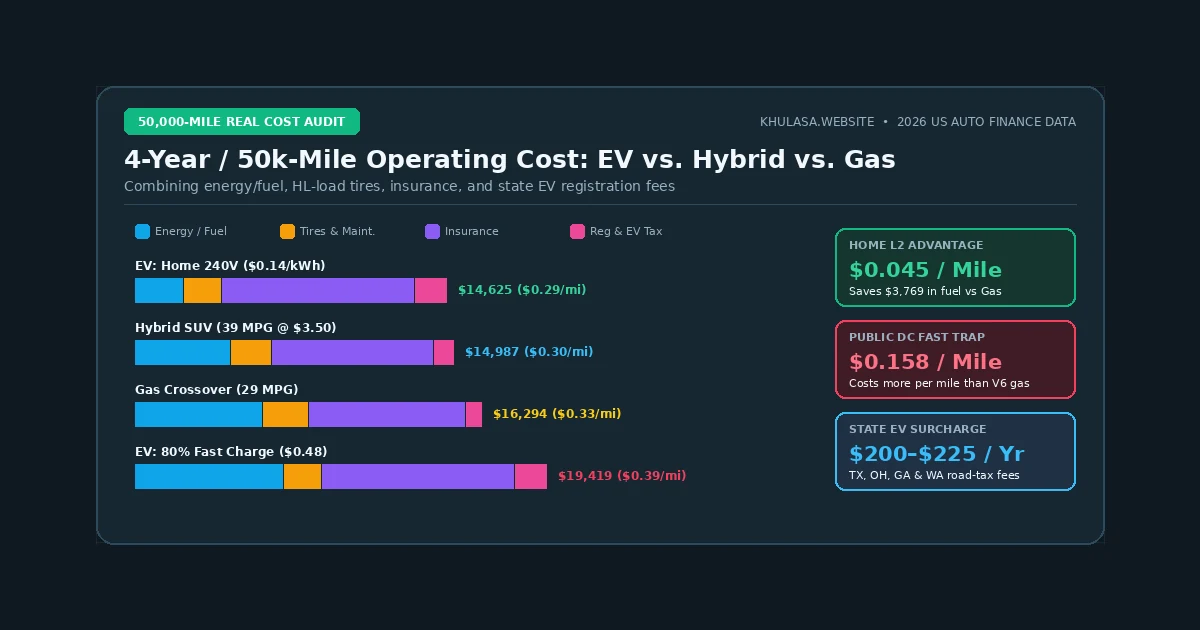
To see how tires, insurance, and state registration fees interact with energy savings, here is our complete out-of-pocket operating audit over 4 years and 50,000 miles (12,500 miles/year) using verified 2026 benchmarks (test your own local utility and gas rates in our EV vs Gas Cost Calculator):
| 50,000-Mile / 4-Year Expense Line | EV Owner A: Home Charging ($0.14/kWh + 11% Loss) | EV Owner B: 80% Public Fast Charging ($0.48/kWh Avg) | Gas Crossover: Honda CR-V (29 MPG @ $3.50/gal) | Hybrid SUV: RAV4 Hybrid (39 MPG @ $3.50/gal) |
|---|---|---|---|---|
| Energy / Fuel (50,000 Miles) | $2,265 (3.4 mi/kWh) | $7,059 (3.4 mi/kWh) | $6,034 (1,724 gal) | $4,487 (1,282 gal) |
| Oil, Filters, Spark Plugs & Fluids | $340 (Cabin filters, brake fluid, wiper fluid) | $340 | $1,180 (7 synthetic oil services, filters, CVT fluid) | $980 (6 synthetic oil services, filters, fluids) |
| Tire Replacements (50,000 Miles) | $1,380 (1 full set of HL/XL EV tires at 30k mi) | $1,380 | $920 (1 set standard touring tires at 45k mi) | $920 (1 set standard touring tires at 45k mi) |
| 4-Year Full-Coverage Auto Insurance | $9,120 ($2,280/yr avg) | $9,120 | $7,440 ($1,860/yr avg) | $7,680 ($1,920/yr avg) |
| State Registration + EV Road-Tax Fee | $1,520 (incl. $200/yr state EV surcharge) | $1,520 | $720 ($180/yr base) | $920 (incl. $50/yr hybrid fee) |
| Total 4-Year / 50k-Mile Operating Cost | $14,625 ($0.2925/mi) | $19,419 ($0.3884/mi) | $16,294 ($0.3259/mi) | $14,987 ($0.2997/mi) |
Why Instant Torque and 4,400-Pound Curb Weights Burn Through EV Tires
Electric vehicles genuinely eliminate engine oil changes, spark plugs, timing belts, oxygen sensors, and transmission fluid flushes. Thanks to regenerative braking, EV brake pads routinely last 85,000 to 100,000+ miles. Physics still collects a toll at the tire shop. A midsize electric crossover carries an 1,100-pound lithium-ion battery pack in its floorpan and delivers 320+ lb-ft of instant torque from 0 RPM. That extra curb weight and launch torque scrub original-equipment tires down to the wear bars in 25,000 to 32,000 miles. Replacement XL- or HL-load (High Load) low-rolling-resistance tires with internal acoustic foam in 19- or 20-inch sizes cost $310 to $380 per tire installed.
Why EV Collision Insurance Runs 18% to 24% Higher
Actuarial loss data from the Highway Loss Data Institute (HLDI) confirms that EVs crash no more often than gas vehicles, yet average collision repair severity runs substantially higher. Structural aluminum castings, LiDAR and radar-packed bumpers, and strict high-voltage battery isolation rules mean that an undercarriage impact or moderate quarter-panel collision can trigger a costly battery pack replacement or total-loss write-off. Always obtain a VIN-specific insurance quote before signing for any EV, and plug that exact premium into our Total Cost of Car Ownership Calculator.
2026 State EV Registration Surcharges: Texas ($200/$400), Ohio ($200), Georgia, and Washington
Because state highway trust funds depend on per-gallon gasoline excise taxes ($0.20 to $0.58+ per gallon), 38 US states now levy a mandatory flat registration surcharge on battery electric vehicles (tracked in the National Conference of State Legislatures (NCSL) EV Fee Registry):
- Texas ($200 Annual Renewal / $400 New Two-Year Registration): Under Texas Transportation Code § 502.360 (Senate Bill 505), Texas charges battery electric vehicles $200 per year at registration renewal, and collects $400 upfront when registering a brand-new EV for its initial two-year inspection and registration period, on top of standard registration and local county road fees.
- Ohio ($200/Year BEV, $100/Year Plug-In Hybrid): Under Ohio Revised Code § 4503.10, the Ohio BMV collects an additional $200 annual registration fee on battery electric vehicles and $100 on plug-in hybrids.
- Georgia (~$214 to $220+ CPI-Adjusted Annual Fee): Georgia indexes its alternative fuel vehicle road-tax fee annually to inflation and fuel-efficiency benchmarks, exceeding $214+ per year for non-commercial passenger EVs.
- Washington State ($225/Year Combined EV Fees): Under RCW 46.17.323 and 46.17.324, Washington charges passenger EVs a $150 electric vehicle registration renewal surcharge plus a $75 transportation electrification fee, totaling $225 per year before regional RTA excise taxes.
Here is the irony for low-mileage drivers. If you only drive 7,500 miles a year in Texas (where the state gas tax is $0.20 per gallon), a 30 MPG gasoline crossover pays just $50 a year in state fuel tax. Paying a flat $200 annual EV surcharge taxes you four times more per mile than a gas driver. Read our Hybrid vs. Gas break-even analysis to see why low-mileage and apartment-dwelling drivers often save more money in a conventional hybrid.